Where According to Aeneas Will the Kingdom of Troy Rise Again
| Aeneid | |
|---|---|
| by Virgil | |
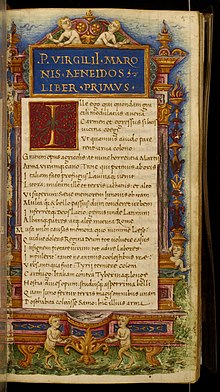 Manuscript circa 1470, Cristoforo Majorana | |
| Original title | AENEIS |
| Translator | John Dryden Gavin Douglas Henry Howard, Earl of Surrey Seamus Heaney Allen Mandelbaum Robert Fitzgerald Robert Fagles Frederick Ahl Sarah Ruden |
| Written | 29–19 BC |
| Country | Roman Democracy |
| Language | Classical Latin |
| Subject(southward) | Ballsy Cycle, Trojan War, Founding of Rome |
| Genre(s) | Epic poem |
| Meter | Dactylic hexameter |
| Publication engagement | 19 BC |
| Media type | Manuscript |
| Lines | 9,896 |
| Preceded by | Georgics |
| Read online | Aeneid at Wikisource |

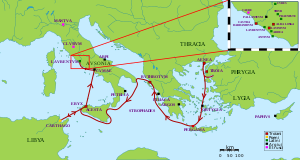
The Aeneid ( ih-NEE-id; Latin: Aenē̆is [ae̯ˈneːɪs] or [ˈae̯neɪs]) is a Latin epic poem, written by Virgil between 29 and 19 BC,[1] that tells the legendary story of Aeneas, a Trojan who fled the fall of Troy and travelled to Italy, where he became the ancestor of the Romans. It comprises 9,896 lines in dactylic hexameter.[2] The offset six of the verse form's twelve books tell the story of Aeneas' wanderings from Troy to Italia, and the verse form'due south 2nd half tells of the Trojans' ultimately victorious war upon the Latins, under whose name Aeneas and his Trojan followers are destined to be subsumed.
The hero Aeneas was already known to Greco-Roman legend and myth, having been a character in the Iliad. Virgil took the disconnected tales of Aeneas' wanderings, his vague association with the foundation of Rome and his description equally a personage of no stock-still characteristics other than a scrupulous pietas, and fashioned the Aeneid into a compelling founding myth or national ballsy that tied Rome to the legends of Troy, explained the Punic Wars, glorified traditional Roman virtues, and legitimized the Julio-Claudian dynasty as descendants of the founders, heroes, and gods of Rome and Troy.
The Aeneid is widely regarded as Virgil's masterpiece[iii] [4] and one of the greatest works of Latin literature.[5] [6]
Story [edit]
The Aeneid tin can exist divided into halves based on the disparate subject field affair of Books 1–6 (Aeneas' journeying to Latium in Italy) and Books vii–12 (the state of war in Latium). These ii-halves are ordinarily regarded as reflecting Virgil's ambition to rival Homer by treating both the Odyssey 's wandering theme and the Iliad 's warfare themes.[seven] This is, however, a rough correspondence, the limitations of which should be borne in mind.[eight]
Journey to Italy (books i–6) [edit]
Theme [edit]
Virgil begins his poem with a statement of his theme (Arma virumque cano ..., "Of arms and the man I sing ...") and an invocation to the Muse, falling some 7 lines after the verse form'southward inception (Musa, mihi causas memora ..., "O Muse, recount to me the causes ..."). He then explains the reason for the chief conflict in the story: the resentment held by the goddess Juno against the Trojan people. This is consistent with her role throughout the Homeric epics.
Book 1: Tempest and refuge [edit]
Also in the manner of Homer, the story proper begins in medias res (into the center of things), with the Trojan fleet in the eastern Mediterranean, heading in the direction of Italian republic. The armada, led by Aeneas, is on a voyage to find a 2nd dwelling house. It has been foretold that in Italy he will give ascent to a race both noble and courageous, a race which will become known to all nations. Juno is wrathful, considering she had not been called in the judgment of Paris, and because her favourite city, Carthage, will be destroyed by Aeneas' descendants. Likewise, Ganymede, a Trojan prince, was chosen to be the cupbearer to her husband, Jupiter—replacing Juno's daughter, Hebe. Juno proceeds to Aeolus, Rex of the Winds, and asks that he release the winds to stir upwards a storm in commutation for a bribe (Deiopea, the loveliest of all her ocean nymphs, every bit a married woman). Aeolus agrees to carry out Juno's orders (line 77, "My job is / To fulfill your commands"); the storm and then devastates the fleet.

Neptune takes notice: although he himself is no friend of the Trojans, he is infuriated by Juno's intrusion into his domain, and stills the winds and calms the waters, subsequently making certain that the winds would non bother the Trojans again, lest they be punished more harshly than they were this time. The fleet takes shelter on the coast of Africa, where Aeneas rouses the spirits of his men, reassuring them that they have been through worse situations before. At that place, Aeneas' mother, Venus, in the form of a huntress very similar to the goddess Diana, encourages him and recounts to him the history of Carthage. Eventually, Aeneas ventures into the city, and in the temple of Juno he seeks and gains the favour of Dido, queen of the metropolis. The city has merely recently been founded by refugees from Tyre and will after become a nifty imperial rival and enemy to Rome.
Meanwhile, Venus has her own plans. She goes to her son, Aeneas' half-brother Cupid, and tells him to imitate Ascanius (the son of Aeneas and his starting time married woman Creusa). Thus disguised, Cupid goes to Dido and offers the gifts expected from a guest. As Dido cradles the boy during a banquet given in honour of the Trojans, Cupid secretly weakens her sworn fidelity to the soul of her late husband Sychaeus, who was murdered by her brother Pygmalion back in Tyre, by inciting fresh love for Aeneas.
Book ii: Trojan Horse and sack of Troy [edit]

Hawara Papyrus 24, with a line of Virgil's Aeneid (repeated 7 times; probably a writing exercise). Book 2, line 601 ( "It is not the hated confront of Spartan Helen..."). Recto. Latin language. 1st century CE. From Hawara, Egypt. On display at the British Museum in London
In books 2 and 3, Aeneas recounts to Dido the events that occasioned the Trojans' inflow. He begins the tale shortly after the state of war described in the Iliad. Cunning Ulysses devised a way for Greek warriors to gain entry into the walled city of Troy by hiding in a large wooden horse. The Greeks pretended to sail away, leaving a warrior, Sinon, to mislead the Trojans into assertive that the horse was an offering and that if it were taken into the city, the Trojans would be able to conquer Hellenic republic. The Trojan priest Laocoön saw through the Greek plot and urged the horse's destruction, simply his protests fell on deaf ears, so he hurled his spear at the horse. Then, in what would be seen by the Trojans as penalization from the gods, 2 serpents emerged from the body of water and devoured Laocoön, along with his two sons. The Trojans then took the horse inside the fortified walls, and after nightfall the armed Greeks emerged from it, opening the urban center'due south gates to allow the returned Greek army to slaughter the Trojans.
In a dream, Hector, the fallen Trojan prince, brash Aeneas to flee with his family. Aeneas awoke and saw with horror what was happening to his beloved city. At first he tried to fight the enemy, but soon he lost his comrades and was left solitary to fend off the Greeks. He witnessed the murder of Priam past Achilles' son Pyrrhus. His mother, Venus, appeared to him and led him back to his house. Aeneas tells of his escape with his son, Ascanius, his wife Creusa, and his male parent, Anchises, after the occurrence of various omens (Ascanius' head communicable fire without his being harmed, a handclapping of thunder and a falling star). At the city gates, they detect they lost Creusa, and Aeneas goes back into the city to wait for her. He only encounters her ghost, who tells him that his destiny is to reach Hesperia, where kingship and a royal spouse expect him.
Book iii: Wanderings [edit]
Aeneas continues his account to Dido past telling how, rallying the other survivors, he built a armada of ships and made landfall at various locations in the Mediterranean: Thrace, where they discover the last remains of a fellow Trojan, Polydorus; Delos, where Apollo tells them to go out and to find the land of their forefathers; Crete, which they believe to exist that land, and where they build their metropolis (Pergamea) and promptly desert information technology after a plague proves this is not the place for them; the Strophades, where they encounter the Harpy Celaeno, who tells them to leave her island and to look for Italian republic, though, she prophesies, they won't find information technology until hunger forces them to eat their tables; and Buthrotum. This terminal city had been built in an effort to replicate Troy. In Buthrotum, Aeneas meets Andromache, the widow of Hector. She is still lamenting the loss of her valiant husband and beloved child. There, as well, Aeneas sees and meets Helenus, one of Priam'southward sons, who has the gift of prophecy. Through him, Aeneas learns the destiny laid out for him: he is divinely advised to seek out the land of Italia (also known every bit Ausonia or Hesperia), where his descendants will not merely prosper, simply in fourth dimension rule the unabridged known globe. In addition, Helenus also bids him become to the Sibyl in Cumae.

Heading into the open sea, Aeneas leaves Buthrotum, rounds the s eastern tip of Italy and makes his way towards Sicily (Trinacria). There, they are caught in the whirlpool of Charybdis and driven out to sea. Soon they come ashore at the state of the Cyclopes. There they meet a Greek, Achaemenides, one of Ulysses' men, who has been left behind when his comrades escaped the cave of Polyphemus. They take Achaemenides on board and narrowly escape Polyphemus. Presently after, at Drepanum, Aeneas' father Anchises dies of one-time age. Aeneas heads on (towards Italy) and gets deflected to Carthage (by the storm described in book i). Here, Aeneas ends his account of his wanderings to Dido.
Book 4: Fate of Queen Dido [edit]
Dido realises that she has fallen in dearest with Aeneas. Juno seizes upon this opportunity to make a deal with Venus, Aeneas' mother, with the intention of distracting Aeneas from his destiny of founding a city in Italy. Aeneas is inclined to return Dido's love, and during a hunting expedition, a storm drives them into a small covered grove in which Aeneas and Dido presumably made love, after which Juno presides over what Dido considers a marriage ceremony. But when Jupiter sends Mercury to remind Aeneas of his duty, he has no choice but to function. At the behest of Mercury'south apparition, he leaves clandestinely at dark. Her center broken, Dido commits suicide past stabbing herself upon a pyre with Aeneas' sword. Earlier dying, she predicts eternal strife between Aeneas' people and hers; "rise up from my basic, avenging spirit" (4.625, trans. Fitzgerald) is a possible invocation to Hannibal.[ix]
Volume 5: Sicily [edit]
Looking dorsum from the deck of his ship, Aeneas sees the smoke of Dido's funeral pyre, and although he does not sympathize the verbal reason behind it, he understands information technology equally a bad omen, considering the angry madness of her beloved.

Battle scene from the Aeneid (volume 5), mosaic floor from a Gallo-Roman villa in Villelaure (French republic), c. 175 AD, Getty Villa (71.AH.106)
Hindered by bad conditions from reaching Italy, the Trojans return to where they started at the kickoff of volume one. Volume v then takes place on Sicily and centers on the funeral games that Aeneas organises for the anniversary of his father's death. Aeneas organises celebratory games for the men—a boat race, a foot race, a boxing friction match, and an archery contest. In all those contests, Aeneas is careful to reward winners and losers, showing his leadership qualities by non allowing antagonism even after foul play. Each of these contests comments on past events or prefigures future events: the boxing lucifer, for instance, is "a preview of the last encounter of Aeneas and Turnus", and the dove, the target during the archery contest, is connected to the deaths of Polites and King Priam in Book two and that of Camilla in Book 11.[10] After, Ascanius leads the boys in a military parade and mock battle, the Lusus Troiae—a tradition he volition teach the Latins while building the walls of Alba Longa.
During these events, Juno, via her messenger Iris, who disguises herself as an old woman, incites the Trojan women to fire the fleet and prevent the Trojans from always reaching Italia, merely her plan is thwarted when Ascanius and Aeneas arbitrate. Aeneas prays to Jupiter to quench the fires, which the god does with a torrential rainstorm. An broken-hearted Aeneas is comforted by a vision of his father, who tells him to go to the underworld to receive a vision of his and Rome'due south future. In render for safe passage to Italy, the gods, by order of Jupiter, will receive one of Aeneas' men as a cede: Palinurus, who steers Aeneas' ship by night, is put to sleep by Somnus and falls overboard.
Book half dozen: Underworld [edit]
Aeneas, with the guidance of the Cumaean Sibyl, descends into the underworld. They pass by crowds of the dead by the banks of the river Acheron and are ferried beyond past Charon before passing by Cerberus, the three-headed guardian of the underworld. Then Aeneas is shown the fates of the wicked in Tartarus and is warned by the Sibyl to bow to the justice of the gods. He also meets the shade of Dido, who remains unreconcilable. He is then brought to dark-green fields of Elysium. In that location he speaks with the spirit of his father and is offered a prophetic vision of the destiny of Rome.
War in Italian republic (books seven–12) [edit]

Roman bas-relief, 2d century: Aeneas lands in Latium, leading Ascanius; the sow identifies the place to found his city (volume 8).
Book seven: Arrival in Latium and outbreak of state of war [edit]
Upon returning to the state of the living, Aeneas leads the Trojans to settle in Latium, where King Latinus received oracles pointing towards the arrival of strangers and bidding him to ally his daughter Lavinia to the foreigners, and not to Turnus, the ruler of another native people, the Rutuli. Juno, unhappy with the Trojans' favourable situation, summons the fury Alecto from the underworld to stir up a war between the Trojans and the locals. Alecto incites Amata, the Queen of Latium and the wife of Latinus, to demand that Lavinia exist married to noble Turnus, and she causes Ascanius to wound a revered deer during a chase. Hence, although Aeneas wishes to avoid a war, hostilities intermission out. The book closes with a catalogue of Italic warriors.
Book 8: Visit to Pallanteum, site of futurity Rome [edit]
Given the impending state of war, Aeneas seeks help from the Tuscans, enemies of the Rutuli, after having been encouraged to exercise so in a dream past Tiberinus. At the place where Rome will be, he meets a friendly Greek, King Evander of Arcadia. His son Pallas agrees to join Aeneas and pb troops against the Rutuli. Venus urges her spouse Vulcan to create weapons for Aeneas, which she and then presents to Aeneas every bit a gift. On the shield, the future history of Rome is depicted.
Volume 9: Turnus' siege of Trojan campsite [edit]
Meanwhile, the Trojan campsite is attacked past Turnus—spurred on past Juno, who informs him that Aeneas is away from his camp—and a midnight raid by the Trojans Nisus and Euryalus on Turnus' camp leads to their expiry. The next day, Turnus manages to alienation the gates but is forced to retreat by jumping into the Tiber.
Book x: Kickoff battle [edit]
A council of the gods is held, in which Venus and Juno speak before Jupiter, and Aeneas returns to the besieged Trojan campsite accompanied by his new Arcadian and Tuscan allies. In the ensuing battle many are slain—notably Pallas, whom Evander has entrusted to Aeneas but who is killed by Turnus. Mezentius, Turnus' shut acquaintance, allows his son Lausus to be killed by Aeneas while he himself flees. He reproaches himself and faces Aeneas in single gainsay—an honourable but essentially futile endeavour leading to his death.
Book 11: Armistice and battle with Camilla [edit]
After a short suspension in which the funeral ceremony for Pallas takes place, the state of war continues. Some other notable native, Camilla, an Amazon character and virgin devoted to Diana, fights bravely only is killed, poisoned past the coward Arruns, who in plow is struck dead by Diana'due south sentinel Opis.
Book 12: Final battle and duel of Aeneas and Turnus [edit]
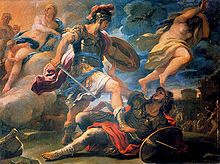
Single combat is proposed between Aeneas and Turnus, but Aeneas is so obviously superior to Turnus that the Rutuli, urged on by Turnus' divine sister, Juturna—who in turn is instigated by Juno—break the truce. Aeneas is injured past an arrow but is soon healed with the help of his mother Venus and returns to the battle. Turnus and Aeneas dominate the battle on reverse wings, but when Aeneas makes a daring attack at the urban center of Latium (causing the queen of Latium to hang herself in despair), he forces Turnus into single combat once again. In the duel, Turnus' strength deserts him as he tries to hurl a rock, and Aeneas' spear goes through his thigh. As Turnus is on his knees, begging for his life, the epic ends with Aeneas initially tempted to obey Turnus' pleas to spare his life, but then killing him in rage when he sees that Turnus is wearing Aeneas' friend Pallas' chugalug over his shoulder as a bays.
Reception [edit]
Critics of the Aeneid focus on a multifariousness of problems.[11] The tone of the poem equally a whole is a particular matter of contend; some see the poem as ultimately pessimistic and politically destructive to the Augustan regime, while others view information technology as a celebration of the new regal dynasty. Virgil makes use of the symbolism of the Augustan government, and some scholars run across potent associations between Augustus and Aeneas, the one equally founder and the other equally re-founder of Rome. A strong teleology, or drive towards a climax, has been detected in the poem. The Aeneid is full of prophecies about the future of Rome, the deeds of Augustus, his ancestors, and famous Romans, and the Carthaginian Wars; the shield of Aeneas even depicts Augustus' victory at Actium in 31 BC. A further focus of report is the grapheme of Aeneas. As the protagonist of the verse form, Aeneas seems to constantly waver between his emotions and commitment to his prophetic duty to constitute Rome; critics note the breakup of Aeneas' emotional control in the last sections of the verse form where the "pious" and "righteous" Aeneas mercilessly slaughters the Latin warrior Turnus.
The Aeneid appears to take been a great success. Virgil is said to accept recited Books 2, 4 and six to Augustus;[12] the mention of her son, Marcellus, in book 6 patently acquired Augustus' sister Octavia to faint. The poem was unfinished when Virgil died in xix BC.
Virgil's death, and editing [edit]
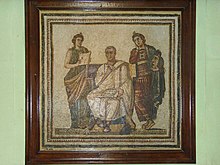
According to tradition, Virgil traveled to Greece around 19 BC to revise the Aeneid. Later on meeting Augustus in Athens and deciding to return abode, Virgil caught a fever while visiting a town well-nigh Megara. Virgil crossed to Italy past ship, weakened with disease, and died in Brundisium harbour on 21 September 19 BC, leaving a wish that the manuscript of the Aeneid was to be burned. Augustus ordered Virgil's literary executors, Lucius Varius Rufus and Plotius Tucca, to disregard that wish, instead ordering the Aeneid to be published with as few editorial changes as possible.[13] : 112 As a result, the existing text of the Aeneid may contain faults which Virgil was planning to correct before publication. All the same, the only obvious imperfections are a few lines of verse that are metrically unfinished (i.e., not a complete line of dactylic hexameter). Other alleged "imperfections" are subject to scholarly debate.
History [edit]

The Aeneid was written in a time of major political and social modify in Rome, with the fall of the Republic and the Final War of the Roman Republic having torn through guild and many Romans' faith in the "Greatness of Rome" severely faltering. However, the new emperor, Augustus Caesar, began to institute a new era of prosperity and peace, specifically through the re-introduction of traditional Roman moral values. The Aeneid was seen as reflecting this aim, by depicting the heroic Aeneas as a man devoted and loyal to his country and its prominence, rather than his ain personal gains. In add-on, the Aeneid gives mythic legitimization to the dominion of Julius Caesar and, by extension, to his adopted son Augustus, past immortalizing the tradition that renamed Aeneas' son, Ascanius (called Ilus from Ilium, significant Troy), Iulus, thus making him an ancestor of the gens Julia, the family of Julius Caesar, and many other great imperial descendants as role of the prophecy given to him in the Underworld. (The meter shows that the proper noun "Iulus" is pronounced as iii syllables, not as "Julus".)
The perceived deficiency of any account of Aeneas' marriage to Lavinia or his founding of the Roman race led some writers, such equally the 15th-century Italian poet Maffeo Vegio (through his Thirteenth Book of the Aeneid widely printed in the Renaissance), Pier Candido Decembrio (whose try was never completed), Claudio Salvucci (in his 1994 epic verse form The Laviniad), and Ursula Grand. Le Guin (in her 2008 novel Lavinia) to compose their ain supplements.
Despite the polished and complex nature of the Aeneid (legend stating that Virgil wrote but three lines of the poem each day), the number of half-consummate lines and the abrupt catastrophe are generally seen as testify that Virgil died before he could cease the piece of work. Some legends state that Virgil, fearing that he would dice earlier he had properly revised the poem, gave instructions to friends (including the current emperor, Augustus) that the Aeneid should be burned upon his death, owing to its unfinished state and because he had come to dislike one of the sequences in Book Eight, in which Venus and Vulcan fabricated dear, for its nonconformity to Roman moral virtues. The friends did non comply with Virgil's wishes and Augustus himself ordered that they be disregarded. After minor modifications, the Aeneid was published. Considering it was composed and preserved in writing rather than orally, the text exhibits less variation than other classical epics.
Style [edit]
As with other classical Latin poesy, the meter is based on the length of syllables rather than the stress, though the coaction of meter and stress is likewise important. Virgil also incorporated such poetic devices as alliteration, onomatopoeia, synecdoche, and assonance. Furthermore, he uses personification, metaphor, and simile in his piece of work, usually to add drama and tension to the scene. An example of a simile tin be establish in volume Ii when Aeneas is compared to a shepherd who stood on the high tiptop of a stone unaware of what is going on around him.[xiv] It tin can be seen that just equally the shepherd is a protector of his sheep, and so as well is Aeneas to his people.
As was the rule in classical antiquity, an author's way was seen equally an expression of his personality and character. Virgil'southward Latin has been praised for its evenness, subtlety and nobility.[ commendation needed ]
Structure [edit]
The Aeneid, similar other classical epics, is written in dactylic hexameters: each line consists of half-dozen metrical feet fabricated up of dactyls (one long syllable followed by ii brusque syllables) and spondees (two long syllables). This epic consists of twelve books, and the narrative is broken up into three sections of iv books each, respectively addressing Dido; the Trojans' inflow in Italia; and the war with the Latins. Each book has roughly 700–900 lines. The Aeneid comes to an abrupt ending, and scholars accept speculated that Virgil died before he could stop the poem.[15]
Themes [edit]
Pietas [edit]
The Roman ideal of pietas ("piety, dutiful respect"), which can be loosely translated from the Latin as a selfless sense of duty toward i's filial, religious, and societal obligations, was a crux of aboriginal Roman morality. Throughout the Aeneid, Aeneas serves as the apotheosis of pietas, with the phrase "pious Aeneas" occurring 20 times throughout the poem,[16] thereby fulfilling his capacity as the father of the Roman people.[17] For instance, in Book two Aeneas describes how he carried his father Anchises from the burning city of Troy: "No help/ Or hope of aid existed./ And then I resigned myself, picked upwards my father,/ And turned my face toward the mountain range."[eighteen] Furthermore, Aeneas ventures into the underworld, thereby fulfilling Anchises' wishes. His father's gratitude is presented in the text past the following lines: "Accept you at last come, has that loyalty/ Your father counted on conquered the journeying? [19]
Nevertheless, Aeneas' pietas extends beyond his devotion to his father: we likewise see several examples of his religious fervour. Aeneas is consistently subservient to the gods, even in actions opposed to his own desires, as he responds to one such divine command, "I sail to Italy non of my own costless will."[20] [21]
In improver to his religious and familial pietas, Aeneas also displays fervent patriotism and devotion to his people, particularly in a military capacity. For case, as he and his followers leave Troy, Aeneas swears that he will "accept up/ The combat again. We shall not all/ Die this day unavenged."[22]
Aeneas is a symbol of pietas in all of its forms, serving as a moral paragon to whom a Roman should aspire.
Divine intervention [edit]
Ane of the near recurring themes in the Aeneid is that of divine intervention.[23] Throughout the poem, the gods are constantly influencing the master characters and trying to modify and impact the outcome, regardless of the fate that they all know will occur.[24] For example, Juno comes downwards and acts as a phantom Aeneas to drive Turnus away from the real Aeneas and all of his rage from the decease of Pallas.[25] Even though Juno knows in the cease that Aeneas volition triumph over Turnus, she does all she can to delay and avoid this outcome.
Divine intervention occurs multiple times, in Book 4 especially. Aeneas falls in love with Dido, delaying his ultimate fate of traveling to Italia. However, it is really the gods who inspired the dear, as Juno plots:
Dido and the Trojan helm [will come]
To one same cave. I shall be on paw,
And if I can exist sure you are willing,
In that location I shall ally them and phone call her his.
A hymeneals, this volition be.[26]
Juno is speaking to Venus, making an understanding and influencing the lives and emotions of both Dido and Aeneas. Later in the same book, Jupiter steps in and restores what is the truthful fate and path for Aeneas, sending Mercury downwardly to Aeneas' dreams, telling him that he must travel to Italy and leave his new-found lover. Equally Aeneas later pleads with Dido:
The gods' interpreter, sent past Jove himself –
I swear it by your caput and mine – has brought
Commands downwards through the racing winds!...
I sail for Italy not of my ain gratis will.[27]
Several of the gods try to intervene against the powers of fate, even though they know what the eventual issue will be. The interventions are really simply distractions to continue the conflict and postpone the inevitable. If the gods represent humans, just as the human characters engage in conflicts and ability struggles, so too exercise the gods.
Fate [edit]
Fate, described as a preordained destiny that men and gods have to follow, is a major theme in the Aeneid. 1 instance is when Aeneas is reminded of his fate through Jupiter and Mercury while he is falling in dearest with Dido. Mercury urges, "Retrieve of your expectations of your heir,/ Iulus, to whom the whole Italian realm, the land/ Of Rome, are due."[28] Mercury is referring to Aeneas' preordained fate to found Rome, as well as Rome'south preordained fate to rule the globe:
He was to be ruler of Italian republic,
Potential empire, armorer of war;
To father men from Teucer's noble blood
And bring the whole earth under law'southward dominion.[29]
It is important to recognize that in that location is a marked difference between fate and divine intervention, every bit fifty-fifty though the gods might remind mortals of their eventual fate, the gods themselves are not in control of it.[30] For example, the opening lines of the poem specify that Aeneas "came to Italy by destiny", but is also harassed by the divide force of "calamitous Juno in her sleepless rage".[31] Fifty-fifty though Juno might intervene, Aeneas' fate is fix in stone and cannot be changed.
Later in Book 6, when Aeneas visits the underworld, his father Anchises introduces him to the larger fate of the Roman people, as assorted against his own personal fate to found Rome:
And so raptly, everywhere, male parent and son
Wandered the blusterous patently and viewed it all.
After Anchises had conducted him
To every region and had fired his love
Of celebrity in the years to come, he spoke
Of wars that he might fight, of Laurentines,
And of Latinus' city, then of how
He might avoid or bear each toil to come.[32]
Violence and conflict [edit]
From the very beginning of the Aeneid, violence and conflict are used as a means of survival and conquest. Aeneas' voyage is caused by the Trojan State of war and the destruction of Troy.[33] Aeneas describes to Dido in Book ii the massive amount of destruction that occurs after the Greeks sneak into Troy. He recalls that he asks his men to "defend/ A city lost in flames. Come, let united states of america die,/ We'll brand a blitz into the thick of information technology."[34] This is 1 of the first examples of how violence begets violence: even though the Trojans know they take lost the boxing, they continue to fight for their land.
This violence continues as Aeneas makes his journey. Dido kills herself in an excessively violent manner over a pyre in order to end and escape her worldly problem: being heartbroken over the departure of her "husband" Aeneas. Queen Dido'south suicide is a double edged sword. While releasing herself from the brunt of her hurting through violence, her last words implore her people to view Aeneas' people with hate for all eternity:
This is my concluding cry, as my concluding claret flows.
And then, O my Tyrians, congregate with hate
His progeny and all his race to come:
Make this your offer to my dust. No love,
No pact must be between our peoples.[35]
Furthermore, her people, hearing of their queen's death, have only one avenue on which to straight the blame: the already-departed Trojans. Thus, Dido's request of her people and her people's only recourse for closure align in their mutual hate for Aeneas and his Trojans. In consequence, Dido's violent suicide leads to the violent nature of the later relationship betwixt Carthage and Rome.[36]
Finally, when Aeneas arrives in Latium, conflict inevitably arises.[37] Juno sends Alecto, 1 of the Furies, to cause Turnus to go confronting Aeneas. In the ensuing battles, Turnus kills Pallas, who is supposed to exist under Aeneas' protection. This deed of violence causes Aeneas to exist consumed with fury. Although Turnus asks for mercy in their last encounter, when Aeneas sees that Turnus has taken Pallas' sword belt, Aeneas proclaims:
You in your plunder, torn from i of mine,
Shall I be robbed of you? This wound volition come
From Pallas: Pallas makes this offering
And from your criminal claret exacts his due.[38]
This final human activity of violence shows how Turnus' violence—the act of killing Pallas—inevitably leads to more than violence and his own death.
Information technology is possible that the recurring theme of violence in the Aeneid is a subtle commentary on the bloody violence contemporary readers would accept just experienced during the Tardily Republican civil wars. The Aeneid potentially explores whether the violence of the civil wars was necessary to found a lasting peace nether Augustus, or whether it would only pb to more than violence in the future.[39]
Propaganda [edit]
Written during the reign of Augustus, the Aeneid presents the hero Aeneas equally a strong and powerful leader. The favourable representation of Aeneas parallels Augustus in that it portrays his reign in a progressive and admirable light, and allows Augustus to be positively associated with the portrayal of Aeneas.[40] Although Virgil's patron Maecenas was plainly not Augustus himself, he was still a high figure within Augustus' administration and could have personally benefitted from representing Aeneas in a positive calorie-free.
In the Aeneid, Aeneas is portrayed equally the atypical hope for the rebirth of the Trojan people. Charged with the preservation of his people past divine say-so, Aeneas is symbolic of Augustus' ain accomplishments in establishing society afterward the long menstruum of chaos of the Roman ceremonious wars. Augustus as the light of savior and the final promise of the Roman people is a parallel to Aeneas as the savior of the Trojans. This parallel functions as propaganda in support of Augustus,[41] [42] as it depicts the Trojan people, future Romans themselves, every bit uniting backside a single leader who volition lead them out of ruin:
New refugees in a great crowd: men and women
Gathered for exile, young-lamentable people
Coming from every quarter, minds made up,
With their belongings, for whatsoever lands
I'd lead them to by body of water.[43]
Later in Book 6, Aeneas travels to the underworld where he sees his male parent Anchises, who tells him of his own destiny every bit well as that of the Roman people. Anchises describes how Aeneas' descendant Romulus will institute the great city of Rome, which will eventually be ruled by Caesar Augustus:
Turn your ii eyes
This mode and see this people, your own Romans.
Here is Caesar, and all the line of Iulus,
All who shall one twenty-four hour period pass under the dome
Of the corking sky: this is the human, this one,
Of whom so often you accept heard the hope,
Caesar Augustus, son of the deified,
Who shall bring once again an Age of Aureate
To Latium, to the land where Saturn reigned
In early times.[44]
Virgil writes about the blighted future of Lavinium, the metropolis that Aeneas will found, which will in turn lead directly to the gold reign of Augustus. Virgil is using a form of literary propaganda to demonstrate the Augustan regime'south destiny to bring glory and peace to Rome. Rather than use Aeneas indirectly as a positive parallel to Augustus as in other parts of the verse form, Virgil outright praises the emperor in Book 6, referring to Augustus as a harbinger for the glory of Rome and new levels of prosperity.
Allegory [edit]
The poem abounds with smaller and greater allegories. Two of the debated allegorical sections pertain to the leave from the underworld and to Pallas' chugalug.
There are two gates of Sleep, one said to exist of horn, whereby the truthful shades pass with ease, the other all white ivory agleam without a flaw, and yet faux dreams are sent through this one by the ghost to the upper globe. Anchises now, his final instructions given, took son and Sibyl and let them become by the Ivory Gate.
—Volume 6, lines 1211–1218, Fitzgerald trans. (emphasis added)
Aeneas' leaving the underworld through the gate of false dreams has been variously interpreted: one proffer is that the passage simply refers to the fourth dimension of day at which Aeneas returned to the world of the living; another is that information technology implies that all of Aeneas' actions in the rest of the poem are somehow "simulated". In an extension of the latter interpretation, it has been suggested that Virgil is carrying that the history of the globe since the foundation of Rome is merely a lie. Other scholars claim that Virgil is establishing that the theological implications of the preceding scene (an apparent system of reincarnation) are not to be taken as literal.[45]
The 2d section in question is
Then to his glance appeared the accurst swordbelt surmounting Turnus' shoulder, shining with its familiar studs—the strap Young Pallas wore when Turnus wounded him and left him dead upon the field; now Turnus diameter that enemy token on his shoulder—enemy still. For when the sight came home to him, Aeneas raged at the relic of his anguish worn past this man as trophy. Blazing up and terrible in his anger, he called out: "You in your plunder, torn from one of mine, shall I be robbed of you? This wound will come up from Pallas: Pallas makes this offering, and from your criminal blood exacts his due." He sank his blade in fury in Turnus' chest ...
—Volume XII, lines 1281–1295, Fitzgerald trans. (accent added)
This section has been interpreted to mean that for the entire passage of the verse form, Aeneas, who symbolizes pietas (piety or morality), in a moment becomes furor (fury), thus destroying what is essentially the primary theme of the poem itself. Many have argued over these 2 sections. Some claim that Virgil meant to change them earlier he died, while others find that the location of the 2 passages, at the very end of the then-called Volume I (Books i–half dozen, the Odyssey), and Book II (Books 7–12, the Iliad), and their brusk length, which contrasts with the lengthy nature of the verse form, are evidence that Virgil placed them purposefully there.
Influence [edit]

The Aeneid is a cornerstone of the Western canon, and early on (at to the lowest degree by the 2d century AD) became 1 of the essential elements of a Latin education,[47] usually required to be memorized.[48] Even afterward the decline of the Roman Empire, information technology "remained central to a Latin education".[49] In Latin-Christian civilisation, the Aeneid was one of the canonical texts, subjected to commentary as a philological and educational study,[50] with the most consummate commentary having been written by the 4th-century grammarian Maurus Servius Honoratus.[51] It was widely held to exist the meridian of Latin literature, much in the same way that the Iliad was seen to be supreme in Greek literature.
The strong influence of the Aeneid has been identified in the development of European vernacular literatures—some English works that show its influence being Beowulf, Layamon'southward Brut (through the source text Historia Regum Britanniae), The Faerie Queene, and Milton's Paradise Lost. The Italian poet Dante Alighieri was himself profoundly influenced by the Aeneid, then much so that his magnum opus The Divine Comedy, itself widely considered central to the western catechism, includes a number of quotations from and allusions to the Aeneid and features the author Virgil as a major character – the guide of Dante through the realms of the Inferno and Purgatorio. Some other continental work displaying the influence of the Aeneid is the 16th-century Portuguese ballsy Os Lusíadas, written past Luís de Camões and dealing with Vasco da Gama's voyage to India.
The importance of Latin education itself was paramount in Western culture: "from 1600 to 1900, the Latin schoolhouse was at the centre of European pedagogy, wherever it was found"; within that Latin school, Virgil was taught at the advanced level and, in 19th-century England, special editions of Virgil were awarded to students who distinguished themselves.[52] In the U.s., Virgil and specifically the Aeneid were taught in the quaternary year of a Latin sequence, at least until the 1960s;[53] the current (2011) Advanced Placement curriculum in Latin continues to assign a cardinal position to the verse form: "The AP Latin: Virgil Examination is designed to examination the pupil's ability to read, translate, understand, analyze, and interpret the lines of the Aeneid that appear on the grade syllabus in Latin."[54]
Many phrases from this poem entered the Latin linguistic communication, much as passages from Shakespeare and Alexander Pope have entered the English linguistic communication. One example is from Aeneas' reaction to a painting of the sack of Troy: Sunt lacrimae rerum et mentem mortalia tangunt—"These are the tears of things, and our mortality cuts to the heart" (Aeneid I, 462). The influence is besides visible in very modern work: Brian Friel's Translations (a play written in the 1980s, set in 19th-century Republic of ireland), makes references to the classics throughout and ends with a passage from the Aeneid:
Urbs antiqua fuit—there was an ancient urban center which, 'tis said, Juno loved in a higher place all the lands. And information technology was the goddess' aim and cherished hope that here should be the upper-case letter of all nations—should the fates maybe permit that. Yet in truth she discovered that a race was springing from Trojan blood to overthrow some day these Tyrian towers—a people late regem belloque superbum—kings of broad realms and proud in state of war who would come forth for Libya'due south downfall.[55]
English translations [edit]
The first full and faithful rendering of the poem in an Anglic language is the Scots translation by Gavin Douglas—his Eneados, completed in 1513, which also included Maffeo Vegio's supplement. Even in the 20th century, Ezra Pound considered this still to be the best Aeneid translation, praising the "richness and fervour" of its linguistic communication and its authentication allegiance to the original.[56] [57] The English translation by the 17th-century poet John Dryden is some other important version. Most classic translations, including both Douglas and Dryden, utilise a rhyme scheme; virtually more than modern attempts do not.
Recent English verse translations include those by British Poet Laureate Cecil Day-Lewis (1963), who strove to render Virgil's original hexameter line; Allen Mandelbaum (honoured by a 1973 National Book Award); Library of Congress Poet Laureate Robert Fitzgerald (1981); Stanley Lombardo (2005); Robert Fagles (2006); Sarah Ruden (2008); Barry B. Powell (2015); David Ferry (2017); Len Krisak (2020); and Shadi Bartsch (2021).[58]
At that place have likewise been fractional translations, such as those past Henry Howard, Earl of Surrey (Volume ii and Volume 4), and Seamus Heaney (Book half-dozen).
Adaptations [edit]
One of the first operas based on the story of the Aeneid was the English composer Henry Purcell's Dido and Aeneas (1688). The opera is famous for its aria "Dido's Lament" ('When I am laid in globe'), of which the first line of the melody is inscribed on the wall by the door of the Purcell Room, a concert hall in London.
The story of the Aeneid was made into the grand opera Les Troyens (1856–1858) by the French composer Hector Berlioz.
The Aeneid was the basis for the 1962 Italian motion-picture show The Avenger and the 1971–1972 television serial Eneide.
In the musical Spring Awakening, based on the play of the same title past Frank Wedekind, schoolboys study the Latin text, and the first verse of Book 1 is incorporated into the number "All That's Known".
Ursula Le Guin'due south 2008 novel Lavinia is a gratis prose retelling of the final six books of the Aeneid narrated past and centered on Aeneas' Latin wife Lavinia, a small-scale grapheme in the ballsy verse form. It carries the action frontwards to the crowning of Aeneas' younger son Silvius as king of Latium.
A seventeenth-century popular broadside ballad as well appears to recount events from books 1–4 of the Aeneid, focusing mostly on the relationship between Aeneas and Dido. The ballad, "The Wandering Prince of Troy", presents many similar elements as Virgil's ballsy, but alters Dido's last sentiments toward Aeneas, as well every bit presenting an interesting end for Aeneas himself.[59]
Parodies and travesties [edit]
A number of parodies and travesties of the Aeneid have been made.[lx]
- One of the earliest was written in Italian by Giovanni Batista Lalli in 1635, titled L'Eneide travestita del Signor Gio.
- A French parody by Paul Scarron became famous in France in the mid-17th century, and spread rapidly through Europe, accompanying the growing French influence. Its influence was specially strong in Russia.
- Charles Cotton's piece of work Scarronides included a travestied Aeneid.
- In 1791 the Russian poet N. P. Osipov published Eneida travestied (Russian: Виргилиева Энеида, вывороченная наизнанку, lit.'Vergil's Aeneid, turned within out').
- In 1798, "Eneida"—Ukrainian mock-heroic caricatural poem, was written by Ivan Kotliarevsky. It is considered to exist the outset literary work published wholly in the modern Ukrainian linguistic communication.[61] His ballsy poem was adapted into an animated characteristic film of the same proper noun, in 1991, past Ukranimafilm.[62]
See also [edit]
- Brutus of Troy
- Franciade
- Greek mythology
- Gulliver'south Travels
- Les Troyens
- List of literary cycles
- Odyssey
- Parallels between Virgil's Aeneid and Homer's Iliad and Odyssey
- Papyrus Oxyrhynchus 31
- Prosody (Latin)
- Roman mythology
- Sinbad the Crewman
- The Voyage of Bran
Footnotes [edit]
- ^ Magill, Frank N. (2003). The Ancient Earth: Dictionary of Earth Biography, Volume 1. Routledge. p. 226. ISBN1135457409.
- ^ Gaskell, Philip (1999). Landmarks in Classical Literature. Chicago: Fitzroy Dearborn. p. 161. ISBNane-57958-192-7.
- ^ "History of Latin Literature". HistoryWorld . Retrieved 5 Dec 2016.
- ^ Aloy, Daniel (22 May 2008). "New translation of 'Aeneid' restores Virgil's wordplay and original meter". Cornell Chronicle . Retrieved v December 2016.
- ^ Damen, Mark (2004). "Affiliate eleven: Vergil and The Aeneid". Retrieved v December 2016.
- ^ Gill, Northward. S. "Why Read the Aeneid in Latin?". Well-nigh.com. Retrieved five December 2016.
- ^ E.G. Knauer, "Vergil's Aeneid and Homer", Greek, Roman, and Byzantine Studies 5 (1964) 61–84. Originating in Servius's observation, tufts.edu
- ^ The majority of the Odyssey is devoted to events on Ithaca, not to Odysseus' wanderings, so that the 2d one-half of the Odyssey very broadly corresponds to the second one-half of the Aeneid (the hero fights to establish himself in his new/renewed home). Joseph Farrell has observed, "... let united states of america begin with the traditional view that Virgil'southward epic divides into 'Odyssean' and 'Iliadic' halves. But accepting this idea at confront value is to error for a destination what Virgil clearly offered as the starting-point of a long and wondrous journey" ("The Virgilian Intertext", Cambridge Companion to Virgil, p. 229).
- ^ Publius Vergilius Maro (2006). The Aeneid, translated past Robert Fagles, introduction by Bernard Knox (palatial ed.). New York, New York: Viking Penguin. p. 26. ISBN978-0-14-310513-8.
- ^ Glazewski, Johanna (1972). "The Office of Vergil's Funeral Games". The Classical World. 66 (2): 85–96. doi:x.2307/4347751. JSTOR 4347751.
- ^ Fowler, "Virgil", in Hornblower and Spawnforth (eds), Oxford Classical Lexicon, 3rd edition, 1996, pp. 1605–06
- ^ Fowler, pg.1603
- ^ Sellar, William Young; Glover, Terrot Reaveley (1911). . In Chisholm, Hugh (ed.). Encyclopædia Britannica. Vol. 28 (11th ed.). Cambridge University Printing. pp. 111–116.
- ^ "Virgil:Aeneid Two". Poetryintranslation.com. Retrieved 27 November 2012.
- ^ Fitzgerald 1990, 416–17.
- ^ Search of the Latin from perseus.tufts.edu
- ^ Hahn, East. Adelaide. "Pietas versus Violentia in the Aeneid." The Classical Weekly, 25.2 (1931): ix–13.
- ^ Fitzgerald 1983, 2.1043–1047.
- ^ Fitzgerald 1983, 6.921–923.
- ^ Fitzgerald 1983, four.499.
- ^ McLeish, Kenneth. "Dido, Aeneas, and the Concept of 'Pietas'." Greece and Rome xix.2 (1972): 127–135.
- ^ Fitzgerald 1983, 2.874–876.
- ^ Coleman, Robert. "The Gods in the Aeneid." Hellenic republic and Rome 29.2 (Oct 1982): 143–168; also run into Cake, E. "The Effects of Divine Manifestation on the Reader's Perspective in Vergil'south Aeneid" (Salem, NH), 1984.
- ^ Duckworth, George Eastward. "Fate and Complimentary Volition in Vergil'southward Aeneid". The Classical Journal 51.viii (1956): 357–364.
- ^ Fitzgerald 1983, 10.890–966.
- ^ Fitzgerald 1983, iv.173–177.
- ^ Fitzgerald 1983, 4.492–499.
- ^ Fitzgerald 1983, four.373–375.
- ^ Fitzgerald 1983, iv.312–315.
- ^ Fitzgerald, Robert, translator and postscript. "Virgil's The Aeneid". New York: Vintage Books (1990). 415.
- ^ Fitzgerald 1983, 1.iii–eight.
- ^ Fitzgerald 1983, six.1203–1210.
- ^ Scully, Stephen. "Refining Fire in "Aeneid" 8." Vergilius (1959–) 46 (2000): 93–113.
- ^ Fitzgerald 1983, iv.469–471.
- ^ Fitzgerald 1983, 4.864–868.
- ^ Fitzgerald, Robert, translator and postscript. "Virgil's The Aeneid". New York: Vintage Books (1990). 407.
- ^ Hahn, E. Adelaide. "Pietas versus Violentia in the Aeneid." The Classical Weekly, 25.two (1931): 9.
- ^ Fitzgerald 1983, 12.1291–1294.
- ^ Pogorselski, Randall J. "The "Reassurance of Fratricide" in The Aeneid." The American Periodical of Philology 130.2 (Summer 2009): 261–289.
- ^ Fitzgerald, Robert, translator and postscript. "Virgil'due south The Aeneid". New York: Vintage Books (1990). 412–414.
- ^ Grebe, Sabine. "Augustus' Divine Authority and Virgil'due south Aeneid." Vergilius (1959–) fifty (2004): 35–62.
- ^ Scully, Stephen. "Refining Burn down in Aeneid 8." Vergilius (1959–) 46 (2000): 91–113.
- ^ Fitzgerald 1983, 2.1036–1040.
- ^ Fitzgerald 1983, half-dozen.1058–1067.
- ^ Trans. David West, "The Aeneid" (1991) xxiii.
- ^ The chestnut, in which the poet read the passage in Book VI in praise of Octavia's late son Marcellus, and Octavia fainted with grief, was recorded in the late fourth-century vita of Virgil by Aelius Donatus.
- ^ Kleinberg, Aviad K. (2008). Flesh Made Word: Saints' Stories and the Western Imagination. Harvard Upwards. p. 68. ISBN978-0-674-02647-half dozen.
- ^ Montaner, Carlos Alberto (2003). Twisted Roots: Latin America's Living Past. Algora. p. 118. ISBN978-0-87586-260-6.
- ^ Horsfall, Nicholas (2000). A Companion to the Report of Virgil . Brill. p. 303. ISBN978-90-04-11951-2.
- ^ Burman, Thomas E. (2009). Reading the Qur'ān in Latin Christendom, 1140–1560. U of Pennsylvania P. p. 84. ISBN978-0-8122-2062-nine.
- ^ Fell, John J.H. (1932). "The Manuscripts of the Commentary of Servius Danielis on Virgil". Harvard Studies in Classical Philology. 43: 77–121. doi:ten.2307/310668. JSTOR 310668.
- ^ Grafton, Anthony; Most, Glenn W.; Settis, Salvatore (2010). The Classical Tradition. Harvard Upwardly. pp. 294–97. ISBN978-0-674-03572-0.
- ^ Skinner, Marilyn B. (2010). A Companion to Catullus. John Wiley. pp. 448â??49. ISBN978-1-4443-3925-iii.
- ^ "Latin : Virgil; Course Description" (PDF). Higher Board. 2011. p. xiv. Retrieved 30 August 2011.
- ^ McGrath, F. C. (1990). "Brian Friel and the Politics of the Anglo-Irish Language". Colby Quarterly. 26 (iv): 247.
- ^ Pound and Spann; Confucius to Cummings: An Album of Poesy, New Directions, p. 34.
- ^ Run across Emily Wilson Passions and a Man Archived 14 September 2008 at the Wayback Automobile, New Republic Online (xi January 2007), which cites Pound's claim that the translation even improved on the Virgil because Douglas had "heard the sea".
- ^ "Aeneid Wars". Athenaeum Review . Retrieved three June 2021.
- ^ Ballad Full Text at the English Broadside Ballad Archive
- ^ [ane] Archived xiv April 2009 at the Wayback Automobile
- ^ "The Aeneid". V.I. Vernadsky National Library of Ukraine. World Digital Library. 1798. Retrieved 25 December 2013.
- ^ "Russian animation in messages and figures | Films | ╚ENEIDA╩". Animator.ru. Retrieved 27 November 2012.
Further reading [edit]
- Buckham, Philip Wentworth; Spence, Joseph; Holdsworth, Edward; Warburton, William; Jortin, John, Miscellanea Virgiliana: In Scriptis Maxime Eruditorum Virorum Varie Dispersa, in Unum Fasciculum Collecta, Cambridge: Printed for Due west. P. Grant; 1825.
- Maronis, P. Vergili (1969), Mynors, R.A.B. (ed.), Opera, Oxford: Oxford University Press, ISBN978-0-19-814653-7
- Virgil (2001), Fairclough, H.R.; Goold, G.P. (eds.), Eclogues, Georgics, Aeneid 1–half-dozen, Loeb Classical Library, Cambridge, Massachusetts: Harvard University Printing, ISBN0-674-99583-X
- Virgil (2001), Fairclough, H.R.; Goold, Thou.P. (eds.), Aeneid Books 7–12, Appendix Vergiliana, Loeb Classical Library, Cambridge, Massachusetts: Harvard Academy Press, ISBN0-674-99586-iv
- Virgil; Ahl, Frederick (trans.) (2007), The Aeneid, Oxford: Oxford Academy Printing, ISBN978-0-19-283206-ane
- Virgil; Fitzgerald, Robert (trans.) (1983), The Aeneid, New York: Random House, ISBN978-0-394-52827-four Paperback reprint: Vintage Books, 1990.
- Virgil: The Aeneid (Landmarks of Earth Literature (Revival)) past K. W. Gransden ISBN 0-521-83213-half dozen
- Virgil'south 'Aeneid': Cosmos and Imperium by Philip R. Hardie ISBN 0-19-814036-iii
- Heinze, Richard (1993), Virgil's Epic Technique, Berkeley: University of California Press, ISBN0-520-06444-5
- Johnson, West.R. (1979), Darkness Visible: A Study of Vergil'south Aeneid, Berkeley: University of California Press, ISBN0-520-03848-vii
- Brooks Otis, Virgil: A Written report in Civilized Poesy, Oxford, 1964
- Lee Fratantuono, Madness Unchained: A Reading of Virgil'southward Aeneid, Lexington Books, 2007.
- Joseph Reed, Virgil's Gaze, Princeton, 2007.
- Kenneth Quinn, Virgil's Aeneid: A Disquisitional Description, London, 1968.
- Francis Cairns, Virgil's Augustan Epic, Cambridge, 1989.
- Gian Biagio Conte, The Poetry of Pathos: Studies in Vergilian Epic, Oxford, 2007.
- Karl Gransden, Virgil's Iliad, Cambridge, 1984.
- Richard Jenkyns, Virgil'due south Experience, Oxford, 1998.
- Michael Burden, A woman scorned; responses to the Dido myth, London, Faber and Faber, 1998, especially Andrew Pinnock, 'Book Four in evidently brown paper wrappers', on the Dido travesties.
- Wolfgang Kofler, Aeneas und Vergil. Untersuchungen zur poetologischen Dimension der Aeneis, Heidelberg 2003.
- Eve Adler, Vergil'due south Empire, Rowman and Littlefield, 2003.
- Nurtantio, Yoneko (2014), Le silence dans l'Énéide, Brussels: EME & InterCommunications, ISBN 978-ii-8066-2928-9
External links [edit]
 | Wikiquote has quotations related to Aeneid . |
 | Wikimedia Commons has media related to Aeneid. |
 | Look up Aeneid in Wiktionary, the gratuitous dictionary. |
Translations [edit]
- The Aeneid at Standard Ebooks
- Perseus Project A.1.1 – Latin text, Dryden translation, and T.C. Williams translation (from the Perseus Project)
- Gutenberg Projection: John Dryden translation (1697)
- Gutenberg Project: J. Due west. Mackail translation (1885)
- Gutenberg Project: Due east. F. Taylor translation (1907)
- Gutenberg Project: Rolfe Humphries translation (1951)
- Fairclough's Loeb Translation (1916) StoicTherapy.com (Complete)
- Fairclough's Loeb Translation (1916) Theoi.com (Books 1–6 only)
- The Online Library of Freedom Project from Liberty Fund, Inc.: The Aeneid (Dryden translation, New York: P.F. Collier and Son, 1909) (PDF and HTML)
-
 The Aeneid public domain audiobook at LibriVox
Text [edit]
- Aeneidos Libri XII Latin text by Publius Vergilius Maro, PDF format
- Menu Page The Aeneid in several formats at Project Gutenberg
- Latin Text Online
Sequels [edit]
- The Thirteenth Book of the Aeneid: a fragment by Pier Candido Decembrio, translated by David Wilson-Okamura
- Supplement to the twelfth book of the Aeneid by Maffeo Vegio at Latin text and English language translation
Illustrations [edit]
- Warburg Establish Iconographic Database (almost 900 images related to the Aeneid)
[edit]
- Commentary on selections from the Latin text at Dickinson Higher Commentaries
- Four talks by scholars on aspects of the Aeneid: Virgil's relationship to Roman history, the Rome of Caesar Augustus, the challenges of translating Latin poesy, and Purcell's opera Dido and Aeneas, delivered at the Maine Humanities Council's Wintertime Weekend program.
- Notes on the political context of the Aeneid.
- Perseus/Tufts: Maurus Servius Honoratus. Commentary on the Aeneid of Vergil. (Latin)
- The Aeneid on In Our Time at the BBC
Source: https://en.wikipedia.org/wiki/Aeneid

Post a Comment for "Where According to Aeneas Will the Kingdom of Troy Rise Again"