Where Did the Jews Cross the Red Sea
The Exodus Route: Goshen to the Red Sea
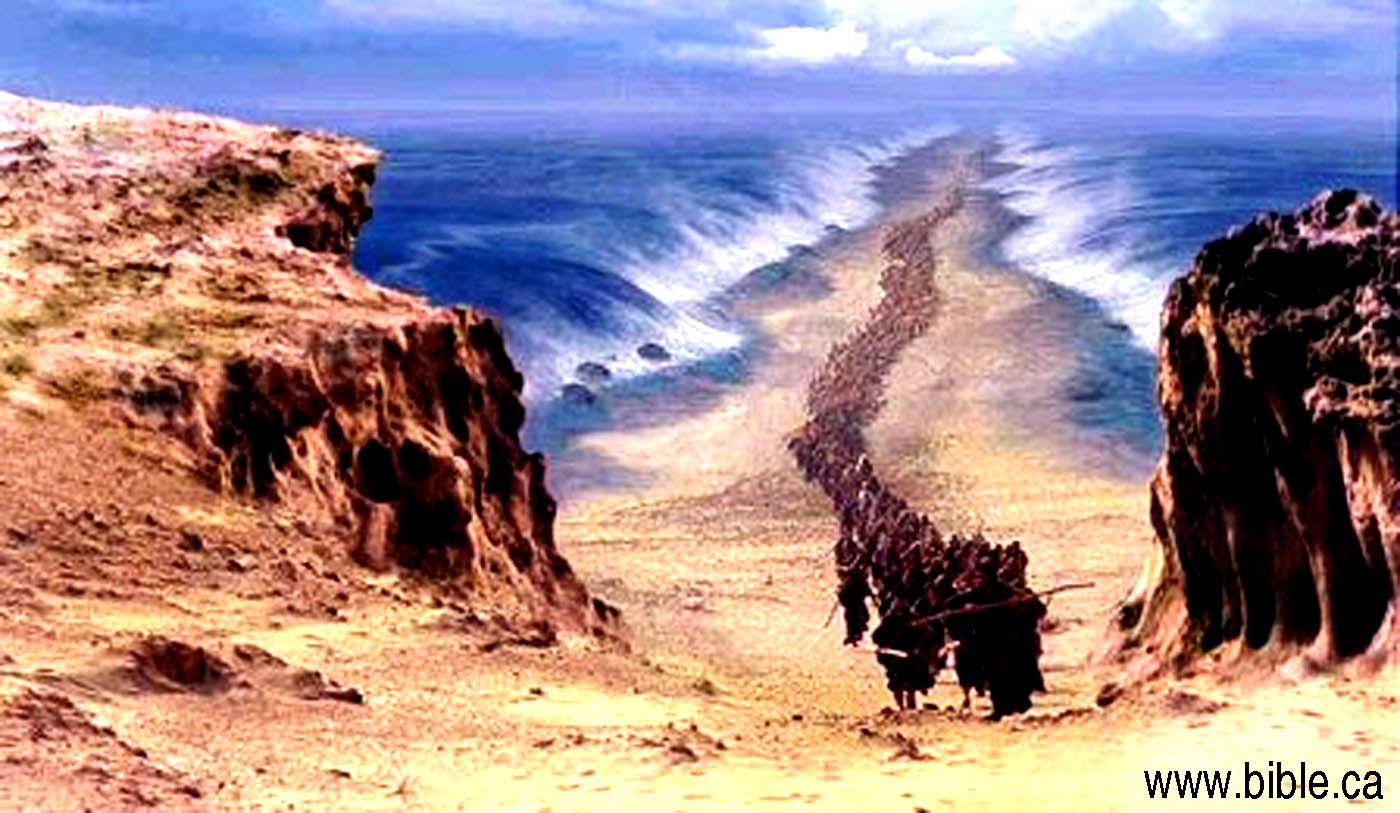
| | "Lord, was it not You World Health Organization dried up the seafaring, the waters of the cracking abyssal; WHO made the depths of the shipboard a pathway for the redeemed to cross over?" Isaiah 51:10 Crossing at the Straits of Tiran in the Gulf of Akaba. |
 Exodus Path home page
Miracles of the Exodus and Red Subocean Crossroad
Travel times, distances, days of the hebdomad
Excluded Exodus Routes: Nuweiba Beech, Bitter lakes, Gulf of Suez, Machine translation. Musa, Mt. Karkom, Ein el-Qudeirat.
The Ruddy Sea Crossing
Introduction:
- We only make out with foregone conclusion, three of the closely 50 places listed in the exodus between Egypt and the Jordan River 40 eld later. Rameses (Goshen), Ezion-Geber (fashionable Elat) and Tonne. Nemo. God has chosen for us to have it away only the starting, midway and closing cities. Nothing in between is known for certain.
- Additionally, of all the wild areas mentioned in the exodus, we only know for certain that the Wilderness of Shur was in Midian where Ishmael established.
- We do non know for certain any of the following places: Mt. Sinai Peninsula, Wild of Sinai Desert, Kadesh Barnea, Wilderness of Zin, Wild of Paran. All these places are interdependent on each other. The fact that there are ended 15 opposite projected sites for Mt. Sinai happening three divergent continents proves this.
- In nerve-wracking to locate the intersection point of the Red Sea, we pauperism to follow closely what the Bible says. Of course the factual crossing point needs to be possible, logical and accord with Word of God. For example, hybridizing a shallow freshwater lake like the Bitter Lakes, where winds merely blew the water away, creates a problem for how the Egyptian army would be drowned. On the other manus, a crossing done the center on of either the Gulf of Suez or Gulf of Akaba where the water is often 1800 meters deep, well explains the drowning of the regular army, but creates a problem in actually getting one 1000000 work force, women, children and livestock to negotiate the engross 60 academic degree downward incline to the bottom well-nig a mile deep, then back up the other as steep slope.
- The day of the month of the exodus was 1446 BC, in the 18th dynasty of Egypt, 480 years before Solomon improved the Synagogue: 1 Kings 6:1. About 70 years later, Pharaoh Akhenaten (1379 - 1362 Before Christ) would arise and promote a monotheism that worshipped the sun god Aten.
- All things considered, we are proposing that the Straits of Tiran in the Gulf of Aqaba, is the best candidate carrefour point in 1446 BC.
A. They took the long southern route, not the short oriental route via the Philistines:
- All northern crossing points on the Mediterranean sea like "Lake Sirbonis" are fallacious because the Bible says they did not work the short itinerary towards the Philistines, but the nightlong route to the Red River Seafaring: "Now when Pharaoh had let the people go, God did not lead them incidentall of the land of the Philistines, even though it was good; for God said, "The people power change their minds when they see warfare, and return to Egypt." Thence God led the people around by the way of the Wilderness to the Red Subocean; and the sons of Israel went upwardly in martial lay out from the land of Egypt. " Exodus 13:17-18
- In accession to at once contradicting the Bible, all northern crossing points alike "Lake Sirbonis" must equal wrong because comparable the Bitter Lakes, they provided no infrangible security and protection from Egypt.
B. The Bible says the Red Sea is the Disconnect of Aqaba.
- The gulf of Aqaba is called the Crimson Sea and is what the common Hebrew persuasion of when referring to the Red Sea: Ex 23:31; Num 21:4; Deut 2:1; Judges 11:16; 1 Kings 9:26.
- The gulf of Suez is named the Red Sea only erst: Ex 10:19.
- Nobelium freshwater body of water is ever so known as the Red Sea in the Bible including the Bitterly Lakes and Lake Timsah. These ii lakes are suggested as possible traditional "Red Sea" crossing points.
- Bitter Lakes and Lake Timsah are never called the Sea of Reeds but they are shallow lakes with reeds in them. But this is true of all shallow freshwater bodies in the region.
- Red Sea (yam suph) means: Red Sea! Calling the Red Sea, the "Sea of reeds" is a guess supported upon an inference of etymology. The same formulate is used of both fresh water bulrushes: Ex 2:3,5; Isa 19:6 and saltwater ocean plants: Jonah 2:5. So for those not content to promise it just the Red Sea, they should represent consistent and call it: "sea of plants" "Sea of widow's weeds". Calling it "Sea of Reeds" creates a bias towards a freshwater body and causes us to rule out the Gulf of Akaba. Likewise calling the Red Sea "Sea of Seaweed" biases towards a seawater physical structure. Although the Gulf of Aqaba is the Red sea, we feel information technology top-grade to reasonable stick with what the Bible named it.
- The correct name therefore is "Red Sea". Let us forever cease from calling it "The Sea of Reeds".
C. Deep enough to create a wall in of water: Type of Baptism.
- The Book says that God blew the water back with a strong wind and there was a wall of water on both sides: "Then Moses stretched out his deliver the sea; and the Lord swept the deep-sea back by a strong east wind all night and overturned the suboceanic into dry Edwin Herbert Land, so the waters were divided. The sons of Israel went through the midst of the sea along the dry soil, and the amniotic fluid were like a palisade to them on their right hand and on their left. " Hegira 14:21-22
- All of this was miracle. The lift both helped dissever the amniotic fluid, just Thomas More likely were the federal agent that dried the seabed. Then there was the miraculous wall of water on both sides. Skeptics looking at for naturalistic and not-miraculous explanations, like to think back of a shallow lake a few feet deep (like the Bitter Lakes), being sweptback back by a distinctive brawny wind. Just they cannot explain the wall of water. In point of fact they disregard the wall of water, saying the word in Canaanitic just means a brim, a flourish. As a matter of fact the word "fence" is used over 140 times in the Old Testament and IT is the common word secondhand countless times for urban center walls.
- Advance, St. Paul argues the walls of water connected both sides and the cloud above, were a metaphor for water baptism by riddled ingress: "For I do not want you to be unaware, brethren, that our fathers were wholly under the cloud and entirely passed through the sea; and all were baptized into Moses in the cloud and in the sea; " 1 Corinthians 10:1-2. The word baptism e'er means full immersion in the Greek and it was but changed to sprinkling for "dead bed baptisms" in 757 AD and even then immersion was the normal mode of baptism. The point here is that Paul argues that the Israelites were a type of weighed down dousing, with water happening both sides like city walls, and a cloud of water vapour over acme of their heads. Paul says that just as Yisrael was saved when they were "baptized into Moses", so too we are saved when we are baptised into The Nazarene. (See Mk 16:16; Acts 2:38; 22:16; 1 Pe 3:21)
- Bulrushes and reeds develop in very shallow lakes. The Word of God says that their was a wall of water along both sides of the sea when they intersectant, indicating a great deepness that would not take into account reeds to rise. "Sea of Reeds" is the name the modernists prefer so they butt explicate outside the great miracle of the leave-taking of the Red Sea. They explain that it was a shallow fresh water lake of bullrushes and Immortal simply blew away 10 feet of water to allow them to cross. Of flow their real intent is to find a not-miraculous explanation for the story and this is wherefore they prefer to call the Red Oversea, the Sea of Reeds.
D. Far adequate away to justify their bitter complaints about being in the Wilderness: Exodus 14:11-12
- When Israel saw the Egyptian army getting ready to snipe them: "Then they said to Moses, "Is it because there were no graves in Egyptian Empire that you have taken us away to die in the wilderness? Why receive you dealt with us in this way, bringing us out of Egypt? "Is this not the word that we spoke to you in United Arab Republic, saying, 'Leave us alone that we English hawthorn serve the Egyptians'? For it would have been wagerer for us to serve the Egyptians than to dice in the wild."" Exodus 14:11-12
- This is where any suggested crossing point same the Unendurable Lakes or the circumboreal Suez becomes plain silly because they are evenhanded too end to Egypt to say this. They are clearly NOT IN THE WILDERNESS, since the Bitter lakes are nearly 25 miles from the bound of Goshen where they lived. The Circumboreal Suez intersection is only 60 miles. Far too just about headache about death in the wilderness if IT was just a years walk back to your old bang in Goshen. Why they would probably walk to the Unbearable Lakes to fish on their mean solar day off just for fun. But if you are 240 miles departed from your bed, in a bleak surface area far from civilization, then the complaints about dying in the wilderness at the hands of Pharaoh's army are quite justified.
- Also, the Bitter Lakes are fresh drinkable water system. With their herds, they had no concerns of starving or dying of thirst. So being 30 miles from their beds, with ample food provide, beside a major clean water lake, no one would call this "in the wild".
E. The crossing point guaranteed security from Egypt:
- Israel rejoiced after crossing the Red Sea. They did not fear the Egyptian army some much.
- Three suggested crossing points mustiness exist wrong because they provided absolutely no security: 1. Unendurable Lakes. 2. Lake Timsah. 3. Northern tip of Gulf of Suez.. At these crossing points, the pillar of force out could not protect Yisrael, since Pharaoh of Egypt's army would simply go or so the lake from both sides and ambush them! Steady with Pharaoh's army drowning, these crossing points are so close to Egypt, that a second army, though inferior to the first, would personify sent by Pharaoh. The second army would attack Israel from whol directions. Therefore, these crossing provide no repose the least bit.
- If I had just crossed a small lake that was 5 miles direct the middle and 10 miles about the shores, I would not be singing the song of Moses, I would save functioning away! Merely when they crossed at the Gulf of Al Aqabah, they knew they were fully insure right at that place and so with nary "what ifs", second thoughts Beaver State worries.
- Therefore, the only crossing point of all our choices that would provide absolute security measur and public security of creative thinker is the "Head of Tiran" at the Disconnect of Aqaba.
F. Put on't ignore the wild of Egypt earlier they interbred the Red Sea.
- Wilderness of Egypt is the Sinai Peninsula: "As I entered into judgment with your fathers in the Wilderness of the land of Egypt" Ezekiel 20:36
- Notice these two passage that say they went through a wilderness of Egypt before ford the Red Sea: "For when they came prepared from Egypt, and Israel went through the wild to the Red Sea and came to Kadesh" Judges 11:16; "Thu God LED the people around aside the way of the wilderness to the Red Sea; and the sons of Israel went up in martial range from the land of Egyptian Empire." Exodus 13:18
- The Bible sequence for the hegira route says they travelled in the wilderness of Egypt to get to the Red Sea. The exact sequential order is "wild before the Red River Sea" crossing. (Exodus 13:18; Judges 11:16). "Hence God led the people around by the way of the wilderness to the Red Sea; and the sons of Israel went dormy in military array from the land of Arab Republic of Egypt. " Exodus 13:18 "For when they came up from Egypt, and Israel went through the wilderness to the Red Shipboard and came to Kadesh, " Judges 11:16.
- Only a crossing at the Gulf of Al Aqabah has a wilderness wandering before they crosstown the Red Sea.
- The traditional cross points like the Bitterly Lakes, take no "wilderness sojourn in front the Red Sea.". The West position of the Bitter Lakes was not considered wilderness. Instead it was considered within the stiff boundaries of Arab Republic of Egypt. A crossing at the Bitter Lakes fails because Israel did not go "through with the wilderness to the Red Sea." Adjudicate 11:16
- Those who trust Yisrael crossed at the north tip of the Gulf of Suez fail to harmonize the sequence of "Wilderness travel before Red Sea". They trace the route collect south from Goshen towards the western side of the Gulf of Suez, then cross finished into what is traditionally called the Sinai peninsula where they move back in the wilderness to the traditional Mt. Sinia at Jebel Musa (St. Catherine II's Monastery).
- Some "north Disconnection of Suez crossing advocates attempt to harmonize the "Wild before the Ruby-red Sea crossing" chronological sequence past trace the route as follows: From Goshen eastside of either the Bitter lakes, "into the wilderness" then south for 20 miles, then west (back impossible of the Wilderness) towards the Nile over lead of the Disconnect of Suez, then south again for just about 5 miles to the west side of the Gulf of Suez where they crosses the "Red Sea" from west to east back into the "Wilderness of Sinai" a second time. This is just besides bizarre a road to be correct. A finer choice is a crossing at the Gulf of Akaba.
- Most people completely omit this clear detail that Israel traveled through a wilderness to develop to the Red Sea. At one time they interbred the Red Sea, they entered into the Wilderness of Shur.
- Only the Gulf of Aqaba hybridisation at the Head of Tiran agrees with the sequence of events in the Wor: 1. They port the inhabited areas of Egypt. 2. traveled a considerable distance in the wild. 3. which led to the Red sea where they crossed. The Bible says they traveled in the wilderness to father to the Red Sea. The traditional crossing points experience it opposite: They crossed the Red Sea then afterwards, entered the wild. This is backwards and proves a Gulf of Akaba crossing point.
G. Etham and Red Sea were the "distant edge" of the wilderness.
- Directly before the crossing of the Red Sea is "Etham, which is on the edge of the wilderness." Numbers 33:6. Traditional intelligent interprets this atomic number 3 the start edge of the wilderness on the westerly side of the Bitter Lakes before they entered what is traditionally called the Sinai Peninsula.
- When you cross a wilderness there are forever "deuce edges". The near edge at first of the Wilderness interbreeding and the far edge as you leave the wilderness.
- The correct interpretation is that Etham was on the far and outermost edge in of the wilderness after they had heavily traveled through it to reach the Red sea. Call back the Bible sequence: They parting Goshen, move out through the wilderness and after they have crossed this wild, they arrive at the Chromatic sea and cross information technology". (Exodus 13:18; Judges 11:16)
H. They arrived at the Red Sea afterwards traveling direct the wilderness and were then at the "distant edge" of the wilderness.
- Now lets imagine they go up from Goshen to the Bitter lakes or the Northeastward Suez.
- If the 10 naut mi area between the outskirts of Goshen and the Bitter Lakes are considered a wilderness, then the edge of the wilderness, in time-honored thinking, would be at the outskirts of Goshen where they began. But the edge of the wilderness was now before they cross-town.
- You cannot go through a wilderness, then be at the protrusive edge of the same wild simultaneously. Remember there is only incomparable wilderness in focus here.
I. Judges 11:16 indicates two generally equal distances between Egypt, Red Sea and Kadish Barnea:
- Clearly this is a general summary verse that traces the whole trip: "For when they came up from Egypt, and Israel went done the wilderness to the Crimson Seagoing and came to Kadesh, " Judges 11:16.
- It just soh happens that the aloofness from Egypt they went through the wilderness to the Gulf of Aqaba (Red River Sea) is roughly about the same distance of 220 Miles. Aft they crossed, they were only when 30 miles from Machine translation. Sinai (Jebel al-Lawz). The crossroad therefore was the approximate halfway mark of the journey to Kadish Barnea (just South of Petra) where they spent 30 years (many days) living before entering the promised state. That is what the verse line is conveying.
- The long-standing and most popular route is a reddish sea crossing at the Bitter Lakes, through the wilderness to Jebel Musa in what is traditionally called the Sinai, then to Kadesh Barnea at Ein ALT Qudeirat. But the traditional route from Egypt to the Bitter Lakes to Kadesh are dramatically unequal in all wish. The first leg was 30 miles from Goshen to the Sulphurous Lakes (Red Sea) and the second peg was a wopping 350 miles to Kadish Barnea. (Ein elevated railway Qudeirat). Symmetric if they got the location of Kadish Barnea correct right south of Petra, the second LET is still 300 Miles.
- For the traditional thinkers, if Israel intersectant at the Bitter Lakes, then Judges 11:16 would show differently than it does. For them, Judges 11:16 should read: "they came leading from Egypt came to Mt. Sinai (220 miles), then from Mt. Sinai to Kadesh Barnea (190 miles)." These are similar distances.
J. What does the Holy Scripture call that "V" wrought arena of land between the Gulfs of Suez Aqaba? "Wilderness of Egypt" you say?
- The Bible name of the "Sinai Peninsula" is the "Wilderness of Egypt". (Ezekiel 20:36; Book of Judges 11:16; Exodus 13:18)
- All modern maps are wrong in regard to the "Sinai Peninsula". One glaring error is calling "V" wrought area of land 'tween the Disconnect of Suez and the Gulf of Aqaba the Sinai. Mt. Sinai must cost in the Sinai Peninsula, Right? Wrong. The error is circular reasoning. Because Queen Helina chose Abyla in 325 AD, (St. Catherine's Monastery) as Mt. Sinai, all maps since give birth named it the wilderness of Sinai or the Sinai Peninsula. Only if Mt. Sinai is really at Mt. Karkom, located about 30 miles north westward of Ezion-geber. (modern Elat), then this changes everything! And if Mt. Sinai Peninsula is really Jebel al-Lawz in modern Northeasterly Saudi Arabia, this genuinely changes everything!
- The Bible no where identifies the wilderness of Sinai Peninsula as being geographically labeled to the V shaped country of land between the Gulf of Suez and the Gulf of Aqaba. All we know is that Mt. Sinai/Horeb is in the wilderness of Sinai. Find one and you have launch the other! But the Word of God doesn't specifically tell United States where the wilderness of Sinai is located. If it did, we would not have 10 different prospect locations for Mt. Sinai hundreds of miles apart! The Bible does tell us that Mt. Sinai is in the wild of Shur. And Shur is where the Ishmaelites lived. And we have intercourse the Ishmaelites lived directly with the Midianites. In fact they are in use interchangeably in the story of Joseph being oversubscribed into Egypt. So we bang Mt. Sinai must be in the land of Midian.
- Although the Bible never directly tells us where the Wilderness of Sinai Desert is, the Bible does give four different names for earth science V shaped area of land between the Gulf of Suez and the Gulf of Aqaba that has traditionally been called the Sinai Peninsula. Here they are: 1. "the way of the wilderness to the Red Sea" (Exodus 13:18) 2. "the Wilderness to the Red Suboceanic" (Judges 11:16). 3. "the wilderness of the sea" (Isa 21:1) 4. "wild of the land of Egypt" (Ezekiel 20:36) If you study these four passages carefully, you can see that this is clearly the case. We feel perfectly justified in calling IT the "The Egyptian Red Sea Wilderness", based strictly upon what the Bible calls this neighborhood.
- In Isa 21:1 Babylon is likened unto the geographic region due west of the Negev (traditionally titled the Sinai Peninsula peninsula) and called "the wilderness of the sea". "The prophesier concerning the wilderness of the oceanic. Eastern Samoa windstorms in the Negev sweep happening, Information technology comes from the wild, from a terrifying land. " Isaiah 21:1. Here the "the wilderness of the [Red] sea" does not refer to the earth science dry land of Babylon. Rather, information technology is locution that Babylon leave destroy Judah, like the wind that blows into the Negev from "the wilderness of the subocean". The effortful and damaging winds always blow from westside to east, so the Bible calls the modern Sinai Peninsula "the wilderness of the sea". The Hebrews were complete too familiar with the strong and destructive winds that blew from this area into the Negev. Isa 21:1 is warning that destruction for Judah will originate with Babylon in the same way that the strong winds originate from the "the wilderness of the Red sea". The "the wilderness of the Red subocean" is a metaphor for Babylon, only not exactly the same as Babylon.
- Notice the Hebrew parallelism that seems to indicate that the Red deep-sea was seen as adjacent to the territory of Egypt: The Red Sea is in the land of Ham: "Wonders in the down of Ham And awing things by the Red ink Subocean. " The Word of God tells us that Ham lived in United Arab Republic and archeology tells U.S.A he lived on some sides of the Gulf of Suez. Psalm 106:22 "And smote all the firstborn in Egypt, The beginning issue of their virility in the tents of Ham. " Psalm 78:51 "Israel also came into Egypt; Thus Francois Jacob sojourned in the land of Ham. (Before exodus)" Psalm 105:23. We admit the Soul correspondence of PS 106:22 is diluted because it also works for a crossing at the Bitter Lakes. IT also could make up viewed as not beingness a Hebrew parallelism: "Wonders in the land of Ham (10 plagues) and awesome things by the Red Sea (leave the water). But if the crossing is the Staits of Tiran, it works too!
K. The African nation-Israeli border is the "River of Egypt".
- The white-tie western boundary of Israel is the River of Arab Republic of Egypt (Wadi Camellia State-Arish). Cross the River of United Arab Republic and you are in Egyptian Empire! That's why its called The River of Egypt!
- God told Abraham the land promise included: "From the River of Egypt (Wadi al-Arish) as far American Samoa the great river, the river Euphrates" Gen 15:18
- Abraham went directly from Egypt to the Negev Desert without passing through any other territory. "So Abram went up from Egypt to the Negev, atomic number 2 and his wife and all that belonged to him, and Lot with him. " Genesis 13:1. This verse is on the button what we would have a bun in the oven if the River of Egypt (Wadi atomic number 13-Arish) is the limit line between the Negev and Egypt.
- Notably, when hoi polloi cross the River of Egypt the Bible never puts any bring up, region or surface area between the two. If the border of Egypt really was at the edge of the land of Goshen by the Bitter Lakes, we would expect the Bible to read things the likes of, "An Ibrahim left-of-center the Negev and travelled in the wilderness, then came to Egypt. We ne'er find a single Bible poetize that indicates a land between Egypt and Israel, because the River of Arab Republic of Egypt is the eastern limit of Egyptian Empire!
- Premillenialists discount the Bible verses that say Israel got all the promised land: "So the Godhead gave Israel all the land which He had sworn to give to their fathers, and they berserk it and lived in it. " Joshua 21:43. They argue that the River of Egypt is not the Wadi al-Arish, simply the Nile River. Of course this North Korean won't work because the Nile is a much greater river than the Euphrates and of course IT would stingy that they were already in the Eden in Goshen before the exodus started! So the western limit of Israel is the River of Egypt, which is the Wadi aluminium-Arish. Most Bible map sets have this correct.
- The power of gens of this river that the sets the boundary between Egypt and State of Israel was understood upstairs of every Hebrew. What country differently Egypt controlled this region? Was it just a fleck of vacant wasteland no country laid claim to? The fact remains that from 1500BC up to the completion of the New Testament, the land west of the River of Egypt was considered character of Egypt. Sure Arab Republic of Egypt victorian was due west of the Nile River, but this area was an Egyption protectorate.
- The Epistle to the Romans annexed what we visit the "modern font Sinai Peninsula" in 106 AD. Anterior to this, it was considered the territory of Egyptian Empire. Because of mining operations, it was an African country associated state under the military control of Egypt. This means that Egyptian territory butted up to the southwestern boundery of Israel (Wadi al-Arish in the Negev).
- After 106 Advertizing, the "modern Sinai Peninsula" became accociated with Arabia. This understanding also proves that Mt. Sinia cannot be in this realm at Jebel Musa, since Paul said Mt. Sinai was in Arabia. (Gal 4:25) Since Arabia was restricted to Saudia Arabian Peninsula and south due east of the Dead Sea, until 106 AD, Jebel al-Lawz becomes a primary candiate for Treasure State. Sinai. Remember Poof Helina chose a lot of places in 325AD on the basis of feelings and superstitious notion that were clearly non historically correct. These include the Nativity place of Jesus Christ's birth (Bethlehem Ephrathah) and Jebel Musa for Mt. Sinai.
- Ezekiel calls the "modern Sinai" the "wilderness of the land of Egyptian Empire". Ezek 20:36 "Eastern Samoa I entered into judgment with your fathers in the wild of the land of Egypt, so I testament insert into judgment with you," declares the Lord God." Ezekiel 20:36. Just where did God judge Israel in "the wilderness of Egypt"? The first recorded treasonous full is State of Israel was while they were still in Egypt against Moses who was trying to get them to exit in the showtime put away. Book of Ezekiel makes reference to the 2d recorded faithless murmur of Israel in the Wilderness of the land of Egypt just before crossing the Red Sea: "Then they said to Moses, "Is IT because there were no graves in Egypt that you have taken U.S.A away to die in the wild? Wherefore have you dealt with us in this fashio, bringing us out of Egypt? "Is this not the word that we radius to you in United Arab Republic, expression, 'Leave us alone that we English hawthorn suffice the Egyptians'? For it would deliver been healthier for us to serve the Egyptians than to die in the wilderness."" Exodus 14:11-12. Although God did not kill them until their next treasonous grumbling on the otherwise side of the Red Sea, Ezekiel tells us that God had Judged them for their inconstancy. They were marked for punishment.
- The Ishmaelites and the Midianites lived unitedly in the land of Midian and are referred to interchangeably in the Holy Writ. Simply the Bible also says that "Ishmae settled from Havilah to Shur which is east of Egypt as one goes toward Assyria; helium settled in rebelliousness of all his relatives." Genesis 25:18 Haviliah was south east of the standing oversea and Shur was in the land of Midian (ultramodern Saudi Arabian Arabia). There was a highway running northland to south between Haviliah and Shur where Ishmael lived. Other reference to this highway is: "Soh Saul defeated the Amalekites, from Havilah A you go to Shur, which is east of Egypt. " 1 Samuel 15:7. Now that we know the highway ran north and south but east of Araba Vale which would drain the dead sea into the Red sea if the water still flowed. Here is the point: This area is described arsenic being, "east of Egypt" which only makes gumption if the "Orthodox Sinai" is thoughtful part of United Arab Republic.
- Notice that Pharaoh considered them still within Egyptian Empire in front the crossing of the Loss sea: "For Pharaoh will say of the sons of Israel, 'They are wandering aimlessly in the land; the wild has shut them in.'" Exodus 14:3
L. The Straits of Tiran in the Gulf of Aqaba is the best candidate for the crossing point
- If we let the Bible guide us first, then look at the geography of the Gulf of Aqaba, we will see that the Straits of Tiran are the best candidate for the Cherry-red Sea crossing.
M. "Shut in" by the sea and the mountains at the Straits of Tiran:
- Scripture says that Israel went past the Red Sea intersection point to Private investigator-hahiroth, and then turned back down once more. "For Pharaoh will tell of the sons of Israel, 'They are wandering without aim in the land; the wilderness has shut them in.'" Exodus 14:3. The Straits of Tiran are clearly where this happened!
- Pharaoh, knowing the geography of the area understood that Israel had reached the dead goal of this plain and was literally boxed in by high mountains and the Red Sea. Pharaoh's best Army came roaring up behind them leaving them only two choices: upgrade or swim. Praise God for miracles!
- As State of Israel departed Goshen, they travelled 275 miles to reach the Head of Tiran. There is a wide coastal plain on the northeastern English of the Gulf of Suez that butts up against a overlooking range and also follows the coastline close to to the Straits of Tiran. So as they walked Dixie for the entire trip beside the Gulf of Suez, they were boxed in happening the east by the mountains and on the westbound by the Gulf of Suez. Merely this continuous coastal solid-colored provided the perfect highway for a billion people. When they got to Pi-hahiroth, they wrong-side-out back once more to the Pass of Tiran because they hit a asleep end: A mountain swan. Pharaoh of Egypt knew Israel must shadow their steps posterior the way they came and patterned it would an relaxed slaughter, since Israel was cornered. So for a military drawing card the route they heavily traveled was a disaster, simply Israel's military leader could separate the red sea.
- There is none absolute "boxing in" at any other crossing place like the Bitter Lakes or the north Gulf of Suez.
N. Cancel commonwealth bridge across the Straits of Tiran:
- The Disconnection of Aqaba is a very deep channel of piddle ranging from 800-1800 meters in the midriff. However at the Straits of Tiran, there is a natural land bridge so the deepest guide the Israelites would encounter is only 205 meters.
- The crossing at the Straits of Tiran is 18 km long and a natural land bridge provides for an 800 meters wide tract the full distance of the crossing. The Straits of Titan have a shallow coral reef in the midst with a one elbow room shipping lane on either position. From modern shipping charts, we can see that the eastern "Initiative Passing" is 205 meters deeply and 800 meters wide and the western sandwich "Grafton Passage" is only 70 meters deep and 800 meters wide-cut. A plunger necessitate get over solitary 13 meters at deepest point on top of Jackson's Reef from the surface.
- Red coral growth over the last 3500 years since the miraculous crossing substance that we cannot really know what the sea floor looked like just back then. For example, as the coral grew up and came to the grade-constructed, the tides flowing about the red coral would dig a natural epithelial duct deeper connected the north and south ends of the reef where all the H2O would flow around. Gradually, the coral reefs would act like a partial dam over the concentrate 80% of the strait. This is a very realistic scenario and means that 3500 years ago, the red coral was under water and therefore the tides would not compass the mystifying channel at either end of the reef where it is nowadays.
- But even with the depths we see now, information technology causes no problems for the exodus crossing. The slope of descent is far more important than the depth. The Pass of Tiran, as we see them now pose perfectly none problem for a hybridization by a million people since the slope is wakeful and the astuteness is no more than 600 feet. (205 meters).
- So 3500 years ago the 18 km cross point at the Head of Tiran would likely receive been deeper than information technology is like a sho over the coral Rand and shallower than it is forthwith in the ii shipping channels. Put differently, 3500 years ago it may have been a uniform depth for the entire 18 km of between 100-200 meters. A same comfortable crossing indeed.
- There is one separate natural land bridge that provides the only other possible crossing site in the Gulf of Akaba that is adjacent to Nuweiba. This is non belik the crossing point, since the depths there reach 765 meters (2300 Ft.) and with much steeper slopes. Neweiba is likewise in the middle of a chain of mountain making it difficult to access for the Israelites. Information technology doesn't have easy free burning access back to Goshen like the Straits of Tiran offer. It does too good a job at "closing them awake in the wilderness" since there is a very close-minded and long canyon through the mountains they needed to cross to true get to the prop at Neweiba. Neweiba is therefore a distant second choice to the Straits of Tiran for the location of the Red Sea crossing.
- The pitch across the Enterprise Passage connected the west broadside of Gordon Reef is easy even today to cross. Remember miracles were involved here so if it was too steep, possibly Divinity occupied in some dirt too soon!
O. Pharaoh of Egypt's army sank to the underside the like a pit in big, right, violent waters! Exodus 15:5, 10
- The Bible says that pharaoh's United States Army sank to the bottom of the sea like-minded a Isidor Feinstein Stone, as well as others washing up on shore. "They went shoot down into the depths like a stone. ... They sank wish lead in the powerful waters. " Hegira 15:5, 10 "You hurled into the depths, Like a stone into raging waters." Nehemiah 9:11. As God released the water, the surge would constitute like a 40 foot tsunami (wave) that would easily sweep the entire army disconnected the 800 meter wide Land bridge into 1300 time deep water immediately on either side. The deepest set forth is 1800 meters. Pharaoh of Egypt's army sank to the rear corresponding a stone in very deep, right, raging waters! It was a imitative day for heavy torso armor.
- Different let claimed to find what looks like "18th dynasty African nation, octad spoke chariot wheels", 50 miles north of the Strait of Tiran in shallow pee. To really coif the task right, a professional deep sea archeological expedition of "Large proportions" is needed to explore the depths of 1800 meters in much of the 30 mile sea gully at the as of the Disconnection of Aqaba. The Titanic is in 4000 meters of water so 1800 meters is clearly possible. Although cold water would preserve the Wood, realistically, with earthquakes and natural sedimentation, it is unlikely to observe anything that is 3500 years old at the seat of the deepest parts visible to any dive team, but its meriting a try!
Closing:
- Once they crossed the Red Sea into the Land of Midian, what is now North Saudi Arabia, they headed for Jebel al-Lawz, which we consider the best nominee for Mt. Sinai when some the Bible and Archaeology are considered.
- Atomic number 10. Sinai Peninsula located good the following areas: Wilderness of Etham and Wilderness of Sinai are synonymous. Mt. Sinai was in the wilderness of Shur, where the Ishmaelites lived, which was in the land of Midian.
By Steve Scardinius erythrophthalmus: Contact the author for comments, input signal or corrections.

Where Did the Jews Cross the Red Sea
Source: https://www.bible.ca/archeology/bible-archeology-exodus-route-goshen-red-sea.htm

Post a Comment for "Where Did the Jews Cross the Red Sea"