One of the Initial Steps a Student Must Understand to Learn to Read Is
Primary Body
3. Word Recognition Skills: One of Two Essential Components of Reading Comprehension
Maria Southward. Murray
Abstract
Afterwards acknowledging the contributions of recent scientific discoveries in reading that accept led to new understandings of reading processes and reading educational activity, this chapter focuses on word recognition, i of the 2 essential components in the Simple View of Reading. The adjacent chapter focuses on the other essential component, language comprehension. The Simple View of Reading is a model, or a representation, of how skillful reading comprehension develops. Although the Study of the National Reading Panel (NRP; National Institute of Child Health and Homo Evolution [NICHD], 2000) concluded that the best reading education incorporates explicit instruction in v areas (phonemic awareness, phonics, fluency, vocabulary, and comprehension), its purpose was to review hundreds of enquiry studies to let instructors know the most effective evidence-based methods for teaching each. These five areas are featured in the Simple View of Reading in such a way that we can encounter how the subskills ultimately contribute to ii essential components for adept reading comprehension. Children require many skills and elements to gain word recognition (due east.one thousand., phoneme awareness, phonics), and many skills and elements to gain linguistic communication comprehension (e.grand., vocabulary). Ultimately, the power to read words (give-and-take recognition) and sympathise those words (linguistic communication comprehension) pb to skilful reading comprehension. Both this chapter and the next affiliate present the skills, elements, and components of reading using the framework of the Simple View of Reading, and in this particular affiliate, the focus is on elements that contribute to automated word recognition. An explanation of each chemical element's importance is provided, along with recommendations of enquiry-based instructional activities for each.
Learning Objectives
After reading this affiliate, readers will be able to
- identify the underlying elements of word recognition;
- identify research-based instructional activities to teach phonological awareness, decoding, and sight recognition of irregular sight words;
- hash out how the underlying elements of discussion recognition lead to successful reading comprehension.
Introduction
Throughout history, many seemingly logical behavior have been debunked through research and science. Alchemists one time believed lead could be turned into gold. Physicians once causeless the flushed ruby pare that occurred during a fever was due to an affluence of blood, and so the "cure" was to remove the excess using leeches (Worsley, 2011). People believed that the world was apartment, that the lord's day orbited the world, and until the discovery of microorganisms such equally bacteria and viruses, they believed that epidemics and plagues were caused by bad air (Byrne, 2012). One by one, these misconceptions were dispelled every bit a result of scientific discovery. The same can be said for misconceptions in instruction, specially in how children acquire to read and how they should be taught to read.1
In just the last few decades there has been a massive shift in what is known most the processes of learning to read. Hundreds of scientific studies have provided us with valuable knowledge regarding what occurs in our brains every bit nosotros read. For example, we now know in that location are specific areas in the brain that process the sounds in our spoken words, dispelling prior beliefs that reading is a visual activity requiring memorization (Rayner, Foorman, Perfetti, Pesetsky, & Seidenberg, 2001). Also, we at present know how the reading processes of students who learn to read with ease differ from those who find learning to read difficult. For example, we have learned that irregular eye movements exercise not cause reading difficulty. Many clever experiments (run into Rayner et al., 2001) have shown that skilled readers' eye movements during reading are smoother than struggling readers' because they are able to read with such ease that they do not have to continually end to figure out letters and words. Maybe most valuable to time to come teachers is the fact that a multitude of studies have converged, showing us which educational activity is most effective in helping people learn to read. For case, we now know that phonics educational activity that is systematic (i.e., phonics elements are taught in an organized sequence that progresses from the simplest patterns to those that are more than complex) and explicit (i.eastward., the teacher explicitly points out what is existence taught every bit opposed to allowing students to effigy it out on their own) is nigh effective for teaching students to read words (NRP, 2000).
Every bit you volition learn, word recognition, or the ability to read words accurately and automatically, is a circuitous, multifaceted process that teachers must understand in lodge to provide effective instruction. Fortunately, we now know a groovy deal nearly how to teach discussion recognition due to important discoveries from electric current research. In this affiliate, you lot will learn what inquiry has shown to be the necessary elements for teaching the underlying skills and elements that lead to accurate and automated word recognition, which is 1 of the ii essential components that leads to skillful reading comprehension. In this textbook, reading comprehension is divers every bit "the process of simultaneously extracting and constructing meaning through interaction and involvement with written language" (Snow, 2002, p. 13), as well every bit the "capacities, abilities, knowledge, and experiences" one brings to the reading state of affairs (p. 11).
Learning to Read Words Is a Complex Process
Information technology used to be a widely held conventionalities by prominent literacy theorists, such as Goodman (1967), that learning to read, like learning to talk, is a natural procedure. It was thought that since children acquire language and how to speak just by virtue of existence spoken to, reading to and with children should naturally lead to learning to read, or recognize, words. Now we know it is not natural, fifty-fifty though it seems that some children "pick upwards reading" similar a bird learns to fly. The human brain is wired from birth for spoken language, merely this is not the case for reading the printed word. This is because what we read—our alphabetic script—is an invention, merely bachelor to humankind for the last 3,800 years (Dehaene, 2009). As a result, our brains have had to accommodate a new pathway to translate the squiggles that are our letters into the sounds of our spoken words that they symbolize. This seemingly simple task is, in actuality, a complex feat.
The alphabet is an amazing invention that allows u.s. to represent both old and new words and ideas with only a few symbols. Despite its efficiency and simplicity, the alphabet is actually the root cause of reading difficulties for many people. The messages that make up our alphabet represent phonemes—individual speech sounds—or according to Dehaene, "atoms" of spoken words (every bit opposed to other scripts like Chinese whereby the characters represent larger units of speech such as syllables or whole words). Individual speech sounds in spoken words (phonemes) are hard to notice for approximately 25% to forty% of children (Adams, Foorman, Lundberg, & Beeler, 1998). In fact, for some children, the ability to detect, or become enlightened of the individual sounds in spoken words (phoneme awareness) proves to exist one of the most difficult academic tasks they will ever encounter. If we were to ask, "How many sounds do you hear when I say 'gum'?" some children may respond that they hear merely one, considering when we say the word "gum," the sounds of /one thousand/ /u/ and /m/ are seamless. (Notation the / / marks denote the sound made by a letter.) This means that the sounds are coarticulated; they overlap and cook into each other, forming an enveloped, single unit—the spoken word "mucilage." At that place are no crisp boundaries between the sounds when nosotros say the discussion "glue." The /one thousand/ sound folds into the /u/ audio, which then folds into the /grand/ sound, with no breaks in between.
Then why the difficulty and where does much of it begin? Our speech consists of whole words, simply we write those words past breaking them down into their phonemes and representing each phoneme with letters. To read and write using our alphabetic script, children must first be able to observe and disconnect each of the sounds in spoken words. They must alloy the individual sounds together to make a whole word (read). And they must segment the individual sounds to represent each with alphabetic letters (spell and write). This is the kickoff stumbling cake for and then many in their literacy journeys—a difficulty in phoneme awareness just because their brains happen to be wired in such a way as to brand the sounds hard to find. Research, through the utilize of brain imaging and diverse clever experiments, has shown how the brain must "teach itself" to accommodate this alphabet by creating a pathway between multiple areas (Dehaene, 2009).
Instruction incorporating phoneme awareness is likely to facilitate successful reading (Adams et al., 1998; Snow, Burns, & Griffin, 1998), and it is for this reason that it is a focus in early on school experiences. For some children, phoneme awareness, forth with exposure to additional fundamentals, such every bit how to hold a book, the concept of a word or judgement, or cognition of the alphabet, may be learned before formal schooling begins. In addition to having such print experiences, oral experiences such equally being talked to and read to inside a literacy rich surroundings help to set the stage for reading. Children defective these literacy experiences prior to starting school must rely heavily on their teachers to provide them.
The Simple View of Reading and the Strands of Early on Literacy Development
Teachers of reading share the goal of helping students develop skillful reading comprehension. As mentioned previously, the Simple View of Reading (Gough & Tunmer, 1986) is a inquiry-supported representation of how reading comprehension develops. It characterizes practiced reading comprehension as a combination of two separate simply equally important components—word recognition skills and language comprehension ability. In other words, to unlock comprehension of text, two keys are required—existence able to read the words on the folio and agreement what the words and linguistic communication hateful within the texts children are reading (Davis, 2006). If a educatee cannot recognize words on the page accurately and automatically, fluency will be affected, and in turn, reading comprehension volition suffer. As well, if a educatee has poor understanding of the pregnant of the words, reading comprehension will suffer. Students who have success with reading comprehension are those who are skilled in both word recognition and language comprehension.
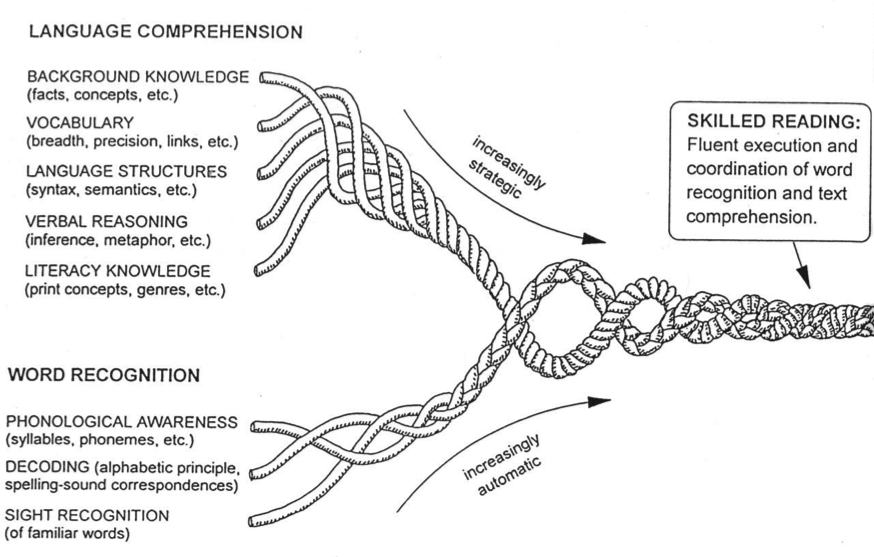
These ii essential components of the Simple View of Reading are represented by an illustration past Scarborough (2002). In her illustration, seen in Figure i, twisting ropes represent the underlying skills and elements that come together to grade two necessary braids that represent the two essential components of reading comprehension. Although the model itself is called "simple" because it points out that reading comprehension is comprised of reading words and understanding the language of the words, in truth the two components are quite complex. Exam of Scarborough's rope model reveals how multifaceted each is. For either of the two essential components to develop successfully, students demand to be taught the elements necessary for automated discussion recognition (i.e., phonological awareness, decoding, sight recognition of frequent/familiar words), and strategic language comprehension (i.e., groundwork knowledge, vocabulary, verbal reasoning, literacy knowledge). The sections below will depict the importance of the three elements that pb to accurate word recognition and provide testify-based instructional methods for each element. Affiliate 4 in this textbook will embrace the elements leading to strategic language comprehension.
Word Recognition
Word recognition is the act of seeing a word and recognizing its pronunciation immediately and without any conscious try. If reading words requires conscious, effortful decoding, picayune attention is left for comprehension of a text to occur. Since reading comprehension is the ultimate goal in educational activity children to read, a disquisitional early objective is to ensure that they are able to read words with instant, automatic recognition (Garnett, 2011). What does automatic word recognition wait similar? Consider your own reading as an instance. Assuming you lot are a skilled reader, it is likely that as you are looking at the words on this page, you cannot avoid reading them. It is impossible to suppress reading the words that you look at on a folio. Because you have learned to instantly recognize so many words to the point of automaticity, a mere glance with no witting try is all it takes for word recognition to take place. Despite this give-and-take recognition that results from a mere glance at impress, it is critical to sympathize that you take not merely recognized what the words look like as wholes, or familiar shapes. Even though we read so many words automatically and instantaneously, our brains still process every letter in the words subconsciously. This is evident when nosotros spot misspellings. For example, when quickly glancing at the words in the familiar sentences, "Jack be nimble, Jack be quick. Jack jamped over the canbleslick," you likely spotted a problem with a few of the individual letters. Yes, you lot instantly recognized the words, still at the aforementioned time you noticed the individual letters inside the words that are not right.
To teach students word recognition and then that they tin can achieve this automaticity, students crave educational activity in: phonological awareness, decoding, and sight recognition of loftier frequency words (e.g., "said," "put"). Each of these elements is defined and their importance is described beneath, forth with effective methods of instruction for each.
Phonological Awareness
One of the critical requirements for decoding, and ultimately give-and-take recognition, is phonological awareness (Snow et al., 1998). Phonological sensation is a broad term encompassing an awareness of various-sized units of sounds in spoken words such as rhymes (whole words), syllables (large parts of words), and phonemes (individual sounds). Hearing "cat" and "mat," and beingness aware that they rhyme, is a form of phonological sensation, and rhyming is unremarkably the easiest and primeval form that children larn. Likewise, existence able to interruption the spoken word "instructor" into 2 syllables is a form of phonological awareness that is more sophisticated. Phoneme awareness, every bit mentioned previously, is an awareness of the smallest individual units of sound in a spoken word—its phonemes; phoneme sensation is the well-nigh advanced level of phonological awareness. Upon hearing the give-and-take "sleigh," children volition exist aware that there are three divide speech sounds—/s/ /l/ /ā/—despite the fact that they may accept no thought what the word looks similar in its printed grade and despite the fact that they would probable accept difficulty reading it.
Because the terms sound similar, phonological sensation is oft confused with phoneme awareness. Teachers should know the difference because awareness of larger units of audio—such as rhymes and syllables—develops before awareness of individual phonemes, and instructional activities meant to develop one awareness may non be suitable for some other. Teachers should besides empathize and retrieve that neither phonological awareness nor its well-nigh advanced course—phoneme awareness—has anything whatever to practice with print or letters. The activities that are used to teach them are entirely auditory. To help think this, simply picture that they can be performed by students if their optics are closed. Adults can teach phonological awareness activities to a child in a car seat during a drive. The kid can be told, "Say 'cowboy.' Now say 'cowboy' without proverb 'cow.'" Adults can teach phoneme awareness activities as well past asking, "What sound do y'all hear at the commencement of 'sssun,' 'sssail,' and 'ssssoup'?" or, "In the word 'snack,' how many sounds exercise you hear?" or by saying, "Tell me the sounds you hear in 'lap.'" Discover that the words would not be printed anywhere; only spoken words are required. Engaging in these game-similar tasks with spoken words helps children develop the awareness of phonemes, which, along with boosted educational activity, will facilitate future word recognition.
Why phonological awareness is important
An abundance of enquiry emerged in the 1970s documenting the importance of phoneme sensation (the about sophisticated form of phonological awareness) for learning to read and write (International Reading Association, 1998). Failing to develop this awareness of the sounds in spoken words leads to difficulties learning the relationship between voice communication and print that is necessary for learning to read (Snowfall et al., 1998). This difficulty can sometimes exist linked to specific underlying causes, such as a lack of instructional experiences to assistance children develop phoneme awareness, or neurobiological differences that brand developing an sensation of phonemes more hard for some children (Rayner et al., 2001). Phoneme awareness facilitates the essential connection that is "reading": the sequences of individual sounds in spoken words match upwardly to sequences of printed letters on a page. To illustrate the connection between phoneme awareness and reading, picture the steps that children must perform as they are start to read and spell words. Starting time, they must accurately sound out the letters, 1 at a time, holding them in memory, so blend them together correctly to form a give-and-take. Conversely, when kickoff to spell words, they must segment a spoken word (fifty-fifty if it is not aural they are still "hearing the word" in their minds) into its phonemes then represent each phoneme with its corresponding letter(s). Therefore, both reading and spelling are dependent on the power to segment and alloy phonemes, likewise as match the sounds to letters, and equally stated previously, some students have smashing difficulty developing these skills. The good news is that these important skills can exist effectively taught, which leads to a discussion well-nigh the nearly effective ways to teach phonological (and phoneme) awareness.
Phonological sensation instruction
The National Reading Panel (NRP, 2000) report synthesized 52 experimental studies that featured instructional activities involving both phonological awareness (e.m., categorizing words similar in either initial sound or rhyme) and phoneme awareness (e.m., segmenting or blending phonemes). In this department, both will exist discussed.

A scientifically based study by Bradley and Bryant (1983) featured an action that teaches phonological sensation and remains popular today. The activeness is sorting or categorizing pictures by either rhyme or initial audio (Bradley & Bryant, 1983). Equally shown in Effigy 2, sets of cards are shown to children that feature pictures of words that rhyme or take the same initial sound. Typically one picture does not match the others in the group, and the students must decide which the "odd" one is. For instance, pictures of a fan, can, man, and squealer are identified to be sure the students know what they are. The instructor slowly pronounces each word to brand sure the students clearly hear the sounds and has them point to the give-and-take that does non rhyme (match the others). This is often referred to equally an "oddity task," and it tin as well exist washed with pictures featuring the same initial sound as in key, clock, cat, and scissors (see Blachman, Ball, Black, & Tangel, 2000 for reproducible examples).
Evidence-based activities to promote phoneme awareness typically accept students segment spoken words into phonemes or have them alloy phonemes together to create words. In fact, the NRP (2000) identified segmenting and blending activities every bit the most effective when teaching phoneme awareness. This makes sense, considering that segmenting and blending are the very acts performed when spelling (segmenting a give-and-take into its individual sounds) and reading (blending letter of the alphabet sounds together to create a discussion). The NRP noted that if segmenting and blending activities eventually incorporate the use of letters, thereby allowing students to make the connectedness betwixt sounds in spoken words and their corresponding messages, there is even greater benefit to reading and spelling. Making connections between sounds and their corresponding letters is the beginning of phonics instruction, which will be described in more than detail below.
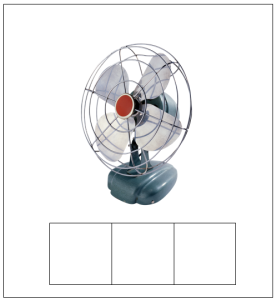
An action that incorporates both segmenting and blending was start developed by a Russian psychologist named Elkonin (1963), and thus, information technology is often referred to equally "Elkonin Boxes." Children are shown a picture representing a iii- or four-phoneme picture (such as "fan" or "lamp") and told to move a chip for each phoneme into a series of boxes below the motion-picture show. For example, if the discussion is "fan," they would say /fffff/ while moving a chip into the offset box, then say /aaaaa/ while moving a chip into the second box, and so on. Both Elkonin boxes (see Figure iii) and a similar activity chosen "Say Information technology and Move Information technology" are used in the published phonological awareness training manual, Road to the Code by Blachman et al. (2000). In each activeness children must listen to a word and motion a corresponding fleck to point the segmented sounds they hear, and they must also blend the sounds together to say the unabridged give-and-take.
Decoding
Another critical component for word recognition is the ability to decode words. When educational activity children to accurately decode words, they must understand the alphabetic principle and know alphabetic character-sound correspondences. When students make the connectedness that letters signify the sounds that nosotros say, they are said to empathize the purpose of the alphabetic code, or the "alphabetic principle." Letter of the alphabet-sound correspondences are known when students tin provide the right sound for letters and letter of the alphabet combinations. Students can then be taught to decode, which means to blend the letter sounds together to read words. Decoding is a deliberate act in which readers must "consciously and deliberately apply their knowledge of the mapping organisation to produce a plausible pronunciation of a word they do not instantly recognize" (Beck & Juel, 1995, p. 9). In one case a discussion is accurately decoded a few times, it is likely to become recognized without conscious deliberation, leading to efficient word recognition.
The instructional practices teachers apply to teach students how messages (e.thou., i, r, ten) and letter clusters (e.1000., sh, oa, igh) stand for to the sounds of speech in English is chosen phonics (not to exist confused with phoneme awareness). For example, a instructor may provide a phonics lesson on how "p" and "h" combine to brand /f/ in "phone," and "graph." After all, the alphabet is a code that symbolizes speech sounds, and once students are taught which audio(s) each of the symbols (letters) represents, they tin can successfully decode written words, or "crack the lawmaking."
Why decoding is of import
Similar to phonological awareness, neither agreement the alphabetic principle nor knowledge of letter of the alphabet-sound correspondences come naturally. Some children are able to proceeds insights near the connections between speech and print on their ain just from exposure and rich literacy experiences, while many others crave instruction. Such instruction results in dramatic improvement in word recognition (Boyer & Ehri, 2011). Students who understand the alphabetic principle and take been taught letter-sound correspondences, through the use of phonological awareness and letter-sound pedagogy, are well-prepared to brainstorm decoding simple words such equally "cat" and "big" accurately and independently. These students volition accept high initial accuracy in decoding, which in itself is important since it increases the likelihood that children volition willingly appoint in reading, and as a result, word recognition will progress. Also, providing students constructive instruction in letter-audio correspondences and how to apply those correspondences to decode is important because the resulting benefits to discussion recognition lead to benefits in reading comprehension (Brady, 2011).
Decoding education
Teaching children alphabetic character-sound correspondences and how to decode may seem remarkably simple and straightforward. Yet teaching them well enough and early on enough then that children can brainstorm to read and cover books independently is influenced past the kind of instruction that is provided. There are many programs and methods bachelor for teaching students to decode, only extensive bear witness exists that instruction that is both systematic and explicit is more constructive than instruction that is non (Brady, 2011; NRP, 2000).
Every bit mentioned previously, systematic education features a logical sequence of letters and letter combinations beginning with those that are the most common and useful, and ending with those that are less so. For instance, knowing the letter "s" is more useful in reading and spelling than knowing "j" because information technology appears in more than words. Explicit instruction is direct; the teacher is straightforward in pointing out the connections betwixt letters and sounds and how to use them to decode words and does not leave it to the students to figure out the connections on their ain from texts. The notable findings of the NRP (2000) regarding systematic and explicit phonics education include that its influence on reading is most substantial when it is introduced in kindergarten and offset grade, it is effective in both preventing and remediating reading difficulties, it is effective in improving both the power to decode words as well as reading comprehension in younger children, and it is helpful to children from all socioeconomic levels. It is worth noting here that effective phonics instruction in the early grades is important so that difficulties with decoding do not persist for students in later on grades. When this happens, it is often noticeable when students in heart school or high school struggle to decode unfamiliar, multisyllabic words.
When providing education in letter-sound correspondences, we should avoid presenting them in alphabetical order. Instead, information technology is more effective to begin with high utility letters such as "a, yard, t, i, s, d, r, f, o, g, l" and so that students tin can begin to decode dozens of words featuring these common letters (e.k., mat, fit, rag, lot). Another reason to avert teaching letter-sound correspondences in alphabetical guild is to forbid letter-audio confusion. Letter confusion occurs in similarly shaped letters (e.g., b/d, p/q, thou/p) because in day-to-day life, changing the direction or orientation of an object such every bit a purse or a vacuum does not change its identity—information technology remains a purse or a vacuum. Some children do not understand that for sure letters, their position in space can change their identity. It may take a while for children to understand that changing the direction of letter b will make information technology into letter of the alphabet d, and that these symbols are not only called different things but also have unlike sounds. Until students gain experience with print—both reading and writing—confusions are typical and are non due to "seeing letters backward." Nor are confusions a "sign" of dyslexia, which is a type of reading trouble that causes difficulty with reading and spelling words (International Dyslexia Association, 2015). Students with dyslexia may contrary letters more often when they read or spell considering they take fewer experiences with print—non because they come across letters backward. To reduce the likelihood of confusion, teach the /d/ audio for "d" to the point that the students know it consistently, before introducing letter of the alphabet "b."
To innovate the alphabetic principle, the Elkonin Boxes or "Say It and Motion It" activities described above can be adapted to include messages on some of the fries. For example, the letter "n" can be printed on a chip and when students are directed to segment the words "nut," "man," or "snap," they tin can motility the "n" flake to represent which sound (e.thousand., the first, second, or terminal) is /n/. As letter-sound correspondences are taught, children should begin to decode by blending them together to form real words (Blachman & Tangel, 2008).
For many students, blending letter of the alphabet sounds together is hard. Some may feel alphabetic character-past-letter of the alphabet distortion when sounding out words i letter at a time. For case, they may read "mat" every bit muh-a-tuh , adding the "uh" sound to the end of consonant sounds. To prevent this, letter of the alphabet sounds should be taught in such a fashion to make sure the educatee does non add the "uh" sound (e.g., "thousand" should be learned as /mmmm/ not /muh/, "r" should be learned as /rrrr/ not /ruh/). To teach students how to alloy letter sounds together to read words, it is helpful to model (run across Blachman & Murray, 2012). Begin with ii letter of the alphabet words such as "at." Write the 2 messages of the discussion separated by a long line: a_______t. Point to the "a" and demonstrate stretching out the curt /a/ audio—/aaaa/ as you move your finger to the "t" to smoothly connect the /a/ to the /t/. Echo this a few times, decreasing the length of the line/fourth dimension between the ii sounds until yous pronounce information technology together: /at/. Gradually motility on to three letter words such equally "sad" by educational activity how to blend the initial consonant with the vowel sound (/sa/) and then calculation the final consonant. Information technology is helpful at offset to utilise continuous sounds in the initial position (e.yard., /s/, /m/, /50/) because they can be stretched and held longer than a "cease consonant" (e.grand., /b/, /t/, /g/).
An excellent activity featured in many scientifically-based research studies that teaches students to decode a word thoroughly and accurately by paying attention to all of the sounds in words rather than guessing based on the initial sounds is word edifice using a pocket chart with letter cards (see examples in Blachman & Tangel). Have students begin past building a word such as "pan" using letter cards p, a, and northward. (These can be made using index cards cut into four 3″ x 1.25″ sections. It is helpful to draw attention to the vowels by making them red equally they are oftentimes difficult to call back and easily dislocated). Next, have them change just one sound in "pan" to make a new give-and-take: "pat." The sequence of words may continue with simply one letter changing at a time: pan — pat — rat — sat — sit — sip — tip — tap — rap. The pupil volition brainstorm to understand that they must mind carefully to which sound has changed (which helps their phoneme sensation) and that all sounds in a word are important. As new phonics elements are taught, the alphabetic character sequences change accordingly. For example, a sequence featuring consonant blends and silent-e may look similar this: slim—slime—slide—glide—glade—blade—blame—shame—sham. Many decoding programs that feature strategies based on scientifically-based inquiry include give-and-take edifice and provide samples ranging from piece of cake, beginning sequences to those that are more advanced (Brook & Beck, 2013; Blachman & Tangel, 2008).
A last important point to mention with regard to decoding is that teachers must consider what makes words (or texts) decodable in guild to allow for acceptable practice of new decoding skills. When letters in a word conform to common letter of the alphabet-sound correspondences, the word is decodable because information technology tin exist sounded out, as opposed to words containing "rule billow" letters and sounds that are in words like "colonel" and "of." The alphabetic character-audio correspondences and phonics elements that take been learned must be considered. For example, even though the letters in the give-and-take "milk shake" conform to common pronunciations, if a student has not yet learned the sound that "sh" makes, or the phonics dominion for a long vowel when there is a silent "eastward," this particular word is not decodable for that child. Teachers should refrain from giving children texts featuring "ship" or "shut" to practice decoding skills until they have been taught the sound of /sh/. Children who accept only been taught the sounds of /s/ and /h/ may decode "shut" /s/ /h/ /u/ /t/, which would not atomic number 82 to high initial accurateness and may atomic number 82 to confusion.
Sight Word Recognition
The third critical component for successful discussion recognition is sight discussion recognition. A small percentage of words cannot be identified past deliberately sounding them out, yet they appear oft in print. They are "exceptions" because some of their letters do non follow common letter-audio correspondences. Examples of such words are "once," "put," and "does." (Notice that in the word "put," yet, that only the vowel makes an exception audio, unlike the sound it would make in similar words such as "gut," "oestrus," or "but.") As a issue of the irregularities, exception words must be memorized; sounding them out will not work.
Since these exception words must ofttimes be memorized as a visual unit (i.e., by sight), they are frequently chosen "sight words," and this leads to confusion amongst teachers. This is because words that occur frequently in print, fifty-fifty those that are decodable (e.chiliad., "in," "will," and "tin"), are also often called "sight words." Of form it is important for these decodable, highly frequent words to be learned early (preferably by attention to their sounds rather than merely past memorization), right along with the others that are not decodable because they appear so often in the texts that will be read. For the purposes of this affiliate, sight words are familiar, high frequency words that must be memorized because they have irregular spellings and cannot be perfectly decoded.
Why sight word recognition is of import
One tertiary of start readers' texts are mostly comprised of familiar, high frequency words such as "the" and "of," and almost half of the words in impress are comprised of the 100 nearly mutual words (Fry, Kress, & Fountoukidis, 2000). It is no wonder that these words demand to be learned to the point of automaticity so that shine, fluent word recognition and reading can have place.
Interestingly, skilled readers who decode well tend to become skilled sight word "recognizers," meaning that they learn irregular sight words more readily than those who decode with difficulty (Gough & Walsh, 1991). This reason is considering as they begin learning to read, they are taught to exist aware of phonemes, they learn letter-sound correspondences, and they put it all together to begin decoding while practicing reading books. While reading a lot of books, they are repeatedly exposed to irregularly spelled, highly frequent sight words, and equally a result of this repetition, they learn sight words to automaticity. Therefore, irregularly spelled sight words can be learned from wide, contained reading of books. However, children who struggle learning to decode do not spend a lot of fourth dimension practicing reading books, and therefore, do non encounter irregularly spelled sight words every bit often. These students will need more than deliberate education and additional practice opportunities.
Sight give-and-take recognition instruction
Teachers should detect that the majority of letters in many irregularly spelled words exercise in fact follow regular sound-symbol pronunciations (east.1000., in the word "from" only the "o" is irregular), and as a event attending to the letters and sounds can often lead to correct pronunciation. That is why information technology is still helpful to teach students to notice all letters in words to ballast them in memory, rather than to encourage "gauge reading" or "looking at the first letter," which are both highly unreliable strategies as anyone who has worked with immature readers will adjure. Interestingly, Tunmer and Chapman (2002) discovered that beginning readers who read unknown words by "sounding them out" outperformed children who employed strategies such every bit guessing, looking at the pictures, rereading the sentence on measures of word reading and reading comprehension, at the stop of their first year in school and at the middle of their 3rd year in schoolhouse.
Other than developing sight word recognition from wide, independent reading of books or from exposure on classroom word walls, instruction in learning sight words is similar to instruction used to learn letter-sound correspondences. Sources of irregularly spelled sight words can vary. For instance, they tin can be preselected from the text that will be used for that solar day's reading instruction. Lists of irregularly spelled sight words can be institute in reading programs or on the Internet (search for Fry lists or Dolch lists). When using such lists, determine which words are irregularly spelled because they will as well feature highly frequent words that tin be decoded, such as "up," and "got." These do non necessarily demand deliberate instructional time because the students volition be able to read them using their noesis of letters and sounds.
Regardless of the source, sight words tin be skillful using wink cards or discussion lists, making sure to review those that accept been previously taught to solidify deep learning. Gradual introduction of new words into the bill of fare piles or lists should include introduction such every bit pointing out features that may help learning and memorization (e.thou., "where" and "there" both accept a tall letter of the alphabet "h" which can be thought of as an arrow or road sign pointing to where or there). Sets of words that share patterns can be taught together (e.yard., "would," "could," and "should"). Games such as Go Fish, Bingo, or Concentration featuring cards with these words tin can build repetition and exposure, and using peer-based learning, students can do speed drills with one some other and tape scores.
Whatsoever action requiring the students to spell the words aloud is as well helpful. I invented an action that I call "Tin You Match Information technology?" in which peers work together to practice a scattering of sight words. An envelope or flap is taped across the acme of a modest dry out erase board. I student chooses a bill of fare, tells the partner what the word is, and then places the bill of fare within the envelope or flap so that it is non visible. The pupil with the dry out erase board writes the word on the section of board that is not covered by the envelope, then opens the envelope to encounter if their spelling matches the word on the bill of fare. The ultimate goal in all of these activities is to provide a lot of repetition and do so that highly frequent, irregularly spelled sight words become words students can recognize with just a glance.
Give-and-take Recognition Summary
Equally seen in the above section, in order for students to achieve automatic and effortless discussion recognition, three important underlying elements—phonological awareness, letter-sound correspondences for decoding, and sight recognition of irregularly spelled familiar words—must be taught to the point that they too are automated. Give-and-take recognition, the act of seeing a discussion and recognizing its pronunciation without conscious effort, is ane of the two critical components in the Unproblematic View of Reading that must be accomplished to enable successful reading comprehension. The other component is language comprehension, which will be discussed in Affiliate four. Both collaborate to grade the skilled process that is reading comprehension. Because they are so crucial to reading, reading comprehension is likened to a ii-lock box, with both "key" components needed to open it (Davis, 2006).
The two essential components in the Simple View of Reading, automatic word recognition and strategic language comprehension, contribute to the ultimate goal of teaching reading: skilled reading comprehension. Co-ordinate to Garnett (2011), fluent execution of the underlying elements equally discussed in this chapter involves "teaching…accompanied by supported and properly framed interactive practice" (p. 311). When discussion recognition becomes effortless and automatic, conscious effort is no longer needed to read the words, and instead information technology tin exist devoted to comprehension of the text. Accuracy and effortlessness, or fluency, in reading words serves to clear the manner for successful reading comprehension.
It is easy to encounter how success in the 3 elements that lead to automatic word recognition are prerequisite to reading comprehension. Learning to decode and to automatically read irregularly spelled sight words can preclude the development of reading problems. Students who are successful in developing effortless word recognition have an easier fourth dimension reading, and this serves as a motivator to immature readers, who and so go along to read a lot. Students who struggle with word recognition discover reading laborious, and this serves as a barrier to young readers, who so may be offered fewer opportunities to read connected text or avoid reading every bit much as possible considering it is difficult. Stanovich (1986) calls this disparity the "Matthew Effects" of reading, where the rich get richer—good readers read more and go even better readers and poor readers lose out. Stanovich (1986) also points out an astonishing quote from Nagy and Anderson (1984, p. 328): "the least motivated children in the middle grades might read 100,000 words a year while the boilerplate children at this level might read 1,000,000. The figure for the voracious centre form reader might exist 10,000,000 or even as loftier as 50,000,000." Imagine the differences in give-and-take and world knowledge that result from reading 100,000 words a year versus millions! Equally teachers, information technology is worthwhile to keep these numbers in mind to remind us of the importance of employing testify-based instructional practices to ensure that all students learn phoneme sensation, decoding, and sight word recognition—the elements necessary for learning how to succeed in word recognition.
Summary
In social club for students to encompass text while reading, information technology is vital that they be able to read the words on the page. Teachers who are aware of the importance of the essential, primal elements which lead to successful word recognition—phonological awareness, decoding, and sight recognition of irregular words—are apt to make sure to teach their students each of these so that their discussion reading becomes automatic, authentic, and effortless. Today'south teachers are fortunate to take bachelor to them a well-established banking company of research and instructional activities that they can access in order to facilitate word recognition in their classrooms.
The Uncomplicated View of Reading'due south two essential components, automatic word recognition and strategic linguistic communication comprehension, combine to allow for skilled reading comprehension. Students who can both recognize the words on the page and understand the language of the words and sentences are much more likely to enjoy the resulting advantage of comprehending the meaning of the texts that they read.
Questions and Activities
- List the 2 main components of the uncomplicated view of reading, and explain their importance in developing reading comprehension.
- Explain the underlying elements of word recognition. How does each contribute to successful reading comprehension?
- Discuss instructional activities that are helpful for instruction phonological awareness, decoding, and sight recognition of irregularly spelled, highly frequent words.
- View the following video showing a pupil named Nathan who has difficulty with word recognition: https://world wide web.youtube.com/sentry?5=lpx7yoBUnKk (Rsogren, 2008). Which of the underlying elements of give-and-take recognition (eastward.g., phonological awareness, letter-sound correspondences, decoding) exercise you believe may be at the root of this educatee'south difficulties? How might you develop a new instructional plan to address these difficulties?
References
Adams, G. J., Foorman, B. R., Lundberg, I., & Beeler, T. (1998). The elusive phoneme: Why phonemic awareness is and so important and how to assist children develop information technology. American Educator, 22, 18-29. Retrieved from http://literacyconnects.org/img/2013/03/the-elusive-phoneme.pdf
Brook, I. 50., & Beck, M. Eastward. (2013). Making sense of phonics: The hows and whys (2d ed.). New York, NY: Guilford Press.
Beck, I. L., & Juel, C. (1995). The office of decoding in learning to read. American Educator, 19, 8-25. Retrieved from http://world wide web.scholastic.com/Dodea/Module_2/resources/dodea_m2_pa_roledecod.pdf
Blachman, B. A., Ball, E. W., Blackness, R., & Tangel, D. Thousand. (2000). Road to the code: A phonological sensation program for young children. Baltimore, MD: Paul H. Brookes Publishing Co.
Blachman, B. A., & Murray, M. S. (2012). Teaching tutorial: Decoding didactics. Charlottesville, VA: Sectionalisation for Learning Disabilities. Retrieved from http://teachingld.org/tutorials
Blachman, B. A., & Tangel, D. Thousand. (2008). Route to reading: A program for preventing and remediating reading difficulties. Baltimore: Brookes Publishing.
Boyer, N., & Ehri, L. (2011). Contribution of phonemic segmentation education with messages and joint pictures to word reading and spelling in beginners. Scientific Studies of Reading, 15, 440-470. doi:10.1080/10888438.2010.520778
Bradley, L., & Bryant, P. E. (1983). Categorizing sounds and learning to read: A causal connection. Nature, 303, 419-421. doi:10.1038/301419a0
Brady, S. (2011). Efficacy of phonics teaching for reading outcomes: Indicators from post-NRP enquiry. In S. A. Brady, D. Braze, & C. A. Fowler (Eds.), Explaining individual differences in reading: Theory and evidence (pp. 69–96). New York, NY: Psychology Press.
Byrne, J. P. (2012). Encyclopedia of the Black Death. Santa Barbara, CA: ABC-CLIO.
Davis, M. (2006). Reading ins truction: The two keys. Charlottesville, VA: Cadre Knowledge Foundation.
Dehaene, Due south. (2009). Reading in the brain. New York, NY: Penguin Books.
Elkonin, D. B. (1963). The psychology of mastering the elements of reading. In B. Simon & J. Simon (Eds.), Educational psychology in the UsaS.R. (pp. 165-179). London, England: Routledge & Kegan Paul.
Fry, E., Kress, J., & Fountoukidis, D. (2000). The reading instructor'south book of lists (quaternary ed.). Paramus, NJ: Prentice-Hall.
Garnett, K. (2011). Fluency in learning to read: Conceptions, misconceptions, learning disabilities, and instructional moves. In J. R. Birsh (Ed.), Multisensory teaching of basic language skills (p. 293-320). Baltimore, MD: Brookes Publishing.
Goodman, 1000. (1967). Reading: A psycholinguistic guessing game. Periodical of the Reading Specialist, 6, 126-135. doi:10.1080/19388076709556976
Gough, P. B., & Tunmer, W. E. (1986). Decoding, reading, and reading disability. Remedial and Special Educational activity, vii, 6-ten. doi:10.1177/074193258600700104
Gough, P. B., & Walsh, K. (1991). Chinese, Phoenicians, and the orthographic cipher of English language. In Due south. Brady & D. Shankweiler (Eds.), Phonological processes in literacy (pp. 199-209). Hillsdale, NJ: Erlbaum.
International Dyslexia Association. (2015). Definition of dyslexia . Retrieved from http://eida.org/definition-of-dyslexia/
International Reading Association. (1998). Phonemic awareness and the education of reading: A position statement from the board of directors of the In ternational R eading A ssociation . Retrieved from http://www.reading.org/Libraries/position-statements-and-resolutions/ps1025_phonemic.pdf
Nagy, Westward., & Anderson, R. C. (1984). How many words are at that place in printed schoolhouse English language? Reading Research Quarterly, xix, 304-330. doi:10.2307/747823
National Found of Kid Wellness and Homo Evolution. (2000). Report of the National Reading Panel: Pedagogy children to read: An prove-based assessment of the scientific research literature on reading and its implications for reading pedagogy: Reports of the subgroups . (NIH Publication No. 00-4754). Washington, DC: U.S. Regime Printing Office. Retrieved from http://www.nichd.nih.gov/publications/pubs/nrp/documents/report.pdf
Rayner, K., Foorman, B. R., Perfetti, C. A., Pesetsky, D., & Seidenberg, Thou. S. (2001). How psychological science informs the teaching of reading. Psychological Science in the Public Interest, 2, 31-74.
Scarborough, H. Southward. (2002). Connecting early linguistic communication and literacy to afterwards reading (dis)abilities: Evidence, theory, and practise. In S. B. Neuman & D. K. Dickinson (Eds.), Handbook of early literacy research (pp. 97-110). New York, NY: Guilford Press.
Snow, C. Due east. (Chair). (2002). Reading for understanding: Toward an R & D program in reading comprehension. Santa Monica, CA: Rand. Retrieved from http://www.prgs.edu/content/dam/rand/pubs/monograph_reports/2005/MR1465.pdf
Snow, C. E., Burns, One thousand. Southward., & Griffin, P. (Eds.). (1998). Preventing reading difficulties in young children. Washington, DC: National Academy Press.
Rsogren, Due north. (2008, June 13). Misunderstood minds chapter 2 [Video file]. Available from https://world wide web.youtube.com/watch?five=lpx7yoBUnKk
Stanovich, K. E. (1986). Matthew effects in reading: Some consequences of individual differences in the acquisition of literacy. Reading Research Quarterly, 21, 360–407. doi:10.1598/RRQ.21.4.one
Tunmer, Due west. E., & Chapman, J. W. (2002). The relation of offset readers' reported discussion identification strategies to reading accomplishment, reading-related skills, and bookish self-perceptions. Reading and Writing: An Interdisciplinary Journal, 15, 341-358. doi:10.1023/A:1015219229515
Worsley, Fifty. (2011). If walls could talk: An intimate history of the domicile. New York, NY: Bloomsbury.
Endnotes
ane: For detailed information on scientifically-based research in education, see Chapter ii past Munger in this volume. Return
Source: https://milnepublishing.geneseo.edu/steps-to-success/chapter/3-word-recognition-skills-one-of-two-essential-components-of-reading-comprehension/

Post a Comment for "One of the Initial Steps a Student Must Understand to Learn to Read Is"