History of All Golf Courses Built by the Dupont Family in Delaware

Map of the history of the DuPont family and company along Delaware Route 141
Along Delaware Road 141 there are a number of historic sites that trace the history of both the Du Pont family unit and the DuPont visitor. At the southwest finish is DuPont's Chestnut Run Plaza and at the northeastern end is the Alfred I. duPont Hospital for Children. Between are a number of sites on the National Annals of Historic Places.
The historic locations include equal portion of the history of the American chemical industry, the role of the DuPont family unit - their estates and gardens[one] - and the philanthropy of a distinguished American family.
Chestnut Run Plaza [edit]

Archway to Anecdote Run Plaza from Delaware Route 141
DuPont Chestnut Run Plaza is a 240-acre (0.97 kmtwo) research facility located on the northeast corner of Eye and Faulkland Roads in Wilmington, Delaware. Construction started in 1952. It is a multi-business research facility dedicated to applied engineering and client service. It consists of nineteen buildings. DuPont business concern currently operating at the facility carry out enquiry on fibers, imaging and printing, agrochemicals, polymers, and most recently hydrogen fuel-cells. Chestnut Run Plaza is a Certified Wild animals Habitat Council Site.[2]
DuPont Airdrome [edit]
The electric current Barley Factory Plaza was originally the site of the DuPont Airport. DuPont owned and operated the individual airfield from 1924 until 1958. Charles Lindbergh'southward "Spirit of St. Louis" made a landing at that place in 1927. 2 du Pont family brothers Richard C. du Pont and Alexis Felix du Pont, Jr. purchased control of the All American Aviation Company in 1937 to obtain air mail technology which was farther developed at the airfield. They grew that company to be Allegheny Airlines which is now known as The states Airways.
The airport holding was sold and and then adult by Pearce Crompton as a multi-use office site. Information technology was leased largely by the DuPont Visitor and eventually purchased past DuPont. It served equally home for the direction of many DuPont business units and DuPont'south Legal Department. It was sold to a local developer and in 2010 it is currently the subject of a contentious rezoning dispute.[three] Barley Mill Plaza is a Certified Wildlife Habitat Council Site.[two]
Pelleport [edit]
This site was once held the private home of William du Pont. Built in the belatedly 1800s, Pelleport was named after i of the family unit's ancestral homes in French republic. Pelleport passed to cousin, Eugene du Pont Sr. whose family occupied the property for two generations. The residence stood vacant for over 25 years until it was razed in 1954 to make room for the Eugene du Pont Convalescent Memorial Hospital.
Christiana Care'south Eugene du Pont Preventive Medicine & Rehabilitation Institute at Pelleport offers a range of programs designed to promote health, prevent disease and minimize disability.
Delaware Road 52 [edit]
Delaware Route 52, also known as Kennett Pike, runs between Wilmington, Delaware and Pennsylvania[4] where it merges into U.Due south. Route 1 near Longwood Gardens. Information technology was built as a price road between the years 1811 and 1813 at a cost of $thirty,000. The structure was authorized by a lease from the Delaware government issued to Christiana Hundred. In 1919, Pierre S. du Pont bought the road and discontinued cost collection. Dupont paved the road following the purchase and thus information technology is referred to as "The Other DuPont Highway",[v] the DuPont Highway beingness U.S. Route 13 in Delaware. Information technology is rumored that Pierre Due south. duPont paved the road so that he and his friends and guests could travel more conveniently between his estate at Longwood Gardens in Kennett Square, Pennsylvania and the DuPont headquarters in Wilmington. It was somewhen sold back to the state. Delaware Routes 52 and 100 plant the Brandywine Breathtaking Byway.[6]

Delaware Route 52 near Winterthur showing Delaware's rolling Chateau Country
Chateau Land [edit]
Route 52 passes thru Delaware's Chateau Country.[vii] Many DuPont homes and estates are tucked abroad in the areas surrounding Greenville, Delaware and Centreville, Delaware.[eight] Local residents take managed to preserve the rural graphic symbol of Route 52 past decision-making evolution. Twin Lakes Brewing Company in Greenville is on the farm of a DuPont heiress.
Winterthur Museum [edit]

Between Greenville and Centerville, one passes Winterthur Museum and Land Manor. The museum in Winterthur, Delaware, houses ane of the most important collections of Americana in the country. Information technology was the former dwelling of Henry Francis du Pont (1880–1969), a renowned collector of antiques and horticulturist.
The grounds are open up to general admission and guided tours are available. The rolling countryside makes the annual Sunday Point-to-Point[9] steeplechases, the carriage, buggy and surrey parade, the running of the hounds, and elegant tailgating a rite of leap in northern Delaware.
Longwood Gardens [edit]

Longwood Gardens is located just beyond the intersection of Pennsylvania Route 52 and U.Southward. Route one. It consists of ane,050 acres (iv.two km2) of gardens, woodlands, and meadows in Kennett Square, Pennsylvania in the Brandywine Creek Valley and is one of the premier botanical gardens in the United States.
The holding that is now Longwood Gardens was originally purchased from William Penn in 1700 past a boyfriend Quaker named George Peirce. In 1798 Joshua and Samuel Peirce planted the first specimens of an arboretum and by 1850 they had amassed one of the finest collections of copse in the nation. Pierre South. du Pont purchased the holding from the Peirce family in 1906 to save the arboretum from being sold for lumber. He made it his individual estate, and from 1906 until the 1930s, du Pont added extensively to the property, the nigh notable additions being the beautiful conservatory, complete with a massive pipe organ, and an extensive organization of fountains. Mr. Du Pont opened his manor to the public many days of the twelvemonth during his occupancy. He founded the Longwood Foundation in 1937, and in 1946 the foundation was chartered with running Longwood Gardens for the general pedagogy and enjoyment of the public. In addition to general admission, the gardens offering many special events during the yr. These include concerts, firework and fountain displays to music, and Christmas lights.
The DuPont Edifice [edit]
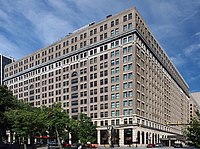
Heading south on Route 52 from Route 141, one enters Wilmington, Delaware, home to the headquarters of the DuPont Company. The most famous DuPont structure in Wilmington is the DuPont Building. The DuPont Edifice occupies the block bound by tenth, 11th, Orange and Marketplace streets. It was 1 of the first loftier-rises in Wilmington, looking out over Rodney Square. The original portion of the building was constructed in 1908 and housed the corporate offices of DuPont. In 1913 the edifice was expanded into a "U" by calculation wings along 10th and 11th streets, the DuPont Playhouse was added, and a portion of the original 1908 department was converted into the Hotel duPont. The last addition to the building occurred in 1923. The building houses DuPont'southward headquarters, the DuPont Theatre (formerly the Playhouse), the Hotel duPont, a bank and a number of small shops and offices.
St. Joseph's on the Brandywine [edit]

St. Joseph'southward on the Brandywine Catholic church was built in 1841 by DuPont visitor stonemasons while in that location was a slack period in building the DuPont pulverization works. The ground adjacent to the DuPont pulverization mills was donated by Charles I. du Pont and the cost of structure was financed largely through loans and gifts from the DuPont company and family.
For eighty years the parish had a shut relationship with the nearby mills. Parishioner's pew rents were collected by the pastor through DuPont Company payroll deductions. When the mills closed, parishioners moved away and past the 1930s information technology appeared that the church building might exist closed likewise. It was saved when people began to motility to the n of Wilmington and to the Greenville, Delaware and Centerville, Delaware areas. It is the domicile parish of United states of america President Joe Biden and several officers of the DuPont Company.
Raskob Estate [edit]

John J. Raskob was hired in 1901 by Pierre South. du Pont as a personal secretary. In 1911, he became assistant treasurer of DuPont, in 1914 treasurer, and in 1918 vice-president for finance of both DuPont and Full general Motors. Raskob had been an early investor in Full general Motors and had engineered DuPont's ownership of 43% of GM, purchased from the financially troubled William C. Durant. While with GM, he led the cosmos of GMAC (at present Marry Financial). He was the builder of the Empire Land Edifice and the project was financed jointly with Pierre S. du Pont.
Like his fellow executives inside DuPont, Raskob was a philanthropist. The Raskob Foundation for Cosmic Activities has its corporate offices at "Irisbrook," the onetime residence of Raskob's younger brother, William F. Raskob. The Foundation is for the purpose of contributing exclusively to religious, charitable, literary and educational activities that will aid the Roman Cosmic Church building and institutions and organizations that are identified with information technology on an international basis. The estate has been divided and is now occupied primarily by the facilities of The Automation Partnership, a company devoted to high throughput screening, genomics automation, informatics, robotic jail cell culture, liquid handling and chemical compound storage and retrieval. The svelte domicile, Irisbrook, is located on the southwest corner of the manor.
Hagley Museum [edit]

Archway to Hagley Museum
Hagley Museum and Library [10] is located on 235 acres (0.95 km2) along the Brandywine Creek. Information technology is "where the du Pont story begins." [eleven] Hagley is the site of the Eleutherian Mills gunpowder works founded by Eleuthère Irénée du Pont in 1802. It provides a glimpse at early American industry and includes restored mills, a workers' community, and the ancestral home and gardens of the du Pont family.
Brandywine Creek [edit]

Manufactory race forth the Brandywine Creek
The Brandywine Creek flows south through the Brandywine Creek State Park, into Wilmington[12] where it flows through Brandywine Park near the city middle. Forth the way it flows past Hagley Museum and Library where it powered the powder mills of the early Dupont company. The flow of the creek is not substantial, though it is reliable, beingness fed by springs in Pennsylvania. There is a considerable drop in the summit of the river in the vicinity of the pulverization works and h2o diverted past several dams into manufacturing plant races provided sufficient power to operate the powder rolling mills. At that place are also dams below the powder works that provided ability for mills located in Wilmington and much of the factory race network is nevertheless in practiced repair.
DuPont Experimental Station [edit]
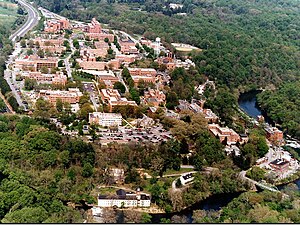
Aerial photograph of the Dupont Experimental Station in the summertime of 1997. The Brandywine Creek is in the immediate foreground and right. The stone edifice in the middle of the picture is the original clubhouse of the Dupont Country Club which has now been displaced to the upper left of the photo. The Nemours Mansion and Gardens is seen in the upper center. Hagley Museum is off the flick to the immediate left. The highway in the upper left is Delaware Road 141, and all of this is function of the DuPont Celebrated Corridor.
The land immediately across the Brandywine Creek from Eleutherian Mills was owned by DuPont for safe reasons. Development was precluded considering the powder mills along the creek were designed in such a fashion that if at that place were any to be whatever explosions (and there were), the smash would be directed at the substantial and heavily-wooded hillside across the creek. Later the mills were closed, DuPont established the DuPont Experimental Station in this location. It was also the location of the original ix holes of the DuPont Country Club, but this golf course was pushed northeastward by the gradual expansion of the Experimental Station.
The DuPont Experimental Station is the largest research and development facility of E. I. du Pont de Nemours and Company and is home to some of the well-nigh important discoveries of the modern chemical industry.[13] [fourteen] Thus, it is not only part of the history of the visitor, it is also playing an important role in DuPont's futurity. It was established in 1903 equally an effort to motility the DuPont Company from gunpowder and explosives into the new age of chemistry. Equally one of the get-go industrial research laboratories in the United States, the 150 acre (0.61 km2) campus-style Experimental Station serves as the main research and development facility for DuPont. It is domicile to DuPont Fundamental Research and most other concern units of DuPont are also represented on site.
The Experimental Station is a Certified Wildlife Habitat Quango Site.[15] In addition to ubiquitous pigeons and crows, creature species that are common on site include eastern cottontails, white-tailed deer, ruby-tailed hawks, groundhogs or woodchucks, eastern gray squirrels, and ruby-throated hummingbirds. Red-tailed hawks and cerise fob proceed populations in control and a nearby colony of turkey vultures continue the grounds complimentary of carrion.
Nemours Mansion and Gardens [edit]

Nemours Mansion from the front
The Nemours Mansion and Gardens is a 300-acre (1.2 kmii) country manor with jardin à la française formal gardens and a classical French mansion. This is all sealed away behind a rock argue topped with glass shards said to have been built to keep out the relatives.
The mansion resembles a Château and contains more than 70 rooms spread over 5 floors occupying about 47,000 sq ft (4,400 grand2). The estate is owned by the Nemours Foundation. Nemours was created by Alfred I. du Pont in 1909–1910, and named for a French town affiliated with his smashing-great-grandfather, Pierre Samuel du Pont de Nemours. Carrère and Hastings designed home in the style of Louis 16—Rococo French architecture. Guided tours are open to the public with reservations highly recommended and required for groups.
Alfred I. DuPont Hospital for Children [edit]

Chief entrance of the Alfred I. DuPont Hospital for Children
The Alfred I. duPont Infirmary for Children is a pediatric hospital located in Wilmington, Delaware. It is controlled by the Nemours Foundation, a non-profit arrangement created by philanthropist Alfred I. du Pont in 1936. With the confidence that it is the duty of everyone to practice what is within his power to alleviate homo suffering, he bestowed an estate valued at $xl meg for the creation of a charitable corporation devoted primarily to providing health care services to children. The resulting Nemours Foundation was charged with the care and treatment of disabled children and the care of depression-income seniors throughout the country of Delaware. Nemours has grown to exist 1 of the nation's largest children's wellness systems caring for more than than a quarter of a million children each yr.
DuPont State Club [edit]

The DuPont Country Club is a recreational facility owned and operated by the Dupont Company.[sixteen] The DuPont State Club was incorporated in 1920, with a total of 600 members. The first "clubhouse" consisted of a two-story house and baseball game diamond and grandstand. The original DuPont Course, a 9-pigsty layout with clay tees and sand greens was designed by Wilfrid Reid, and constructed in 1921. This original course was lost to the expansion of the DuPont Experimental Station and ii new courses and a clubhouse were built on their present site. The clubhouse of the original form became the cafeteria of Experimental Station employees and the original pro-shop became the domicile of the DuPont employees' credit union.
Brantwyn [edit]

Brantwyn at the DuPont Country Club
The DuPont State Social club also includes the Dupont estate, Brantwyn, the childhood dwelling of Pierre S. du Pont, Four. The home's name is probable a derivative of the name Brandywine. The creek's name may be from an onetime Dutch word for brandy or gin, brandewijn, or from the name of an early mill possessor, Andreas Brainwende or Brantwyn.[17]
Blue Ball Barn [edit]

Front view of the DuPont dairy barn at BlueBall.
Off the map is an extraordinary dairy befouled, built in 1914 by Alfred I. DuPont to service Nemours. Adjacent is a glass-tiled milk-house. The facility was designed to exist the virtually mod dairy barn in the United States at the time. The upper floor of the barn stored feed for the cattle. The milking parlor and calving area occupied the lower level. Cattle waiting to be milked were kept in a stucco-walled courtyard.
It is named afterwards the Blueish Ball Tavern, an inn and coming together house, that was one time located near the property. A blue ball attached to a pole in front of the tavern served as a bespeak to stagecoach drivers to stop to pick upward passengers, hence the name "Blue Ball Tavern." The preserved and renovated Blue Ball Barn is the centerpiece of the new Alapocas Run State Park. The Blue Ball Barn is permanent home to the Delaware Folk Art Collection and in that location is an exhibit on the history of the barn.
Gallery [edit]
-

The DuPont Edifice (center left) and the Nemours Edifice (right) in 2006.
-

The DuPont building from the corner of Market and 10th with the Wilmington Trust co-operative.
-

Fairway of the DuPont Country Club
-

Carillon at the Nemours Manor
-

Brandywine Creek just beneath Hagley Museum
-

Side view of the Blue Ball dairy befouled that was function of the Nemours estate
-

A cottage in the "Enchanted Garden" section of the grounds, intended for families with children
-
-
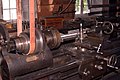
Machinery in Hagley Museum's workshop
-

Frolic Weymouth driving his passenger vehicle at the caput of Winterthur'south Bespeak-to-Point carriage parade.
-

Steeplechase at Winterthur'southward Signal-to-Point.
-

Master archway to the DuPont Experimental Station at the Tyler McConnell Bridge spanning Brandywine Creek
-

Army camp Brandywine celebrated marking in Greenville, Delaware
-

Hotel DuPont cornerstone
-

Wilmington: A Place to Be Somebody
References [edit]
- ^ http://dspace.udel.edu:8080/dspace/bitstream/handle/19716/2946/varley_1995-spring.pdf;jsessionid=76CE2D1D7391F932EE01381E76DF9BEB?sequence=1%7CThesis Archived 2012-03-sixteen at the Wayback Motorcar: The DuPont Family Legacy Of Horticulture in The Brandywine Valley by Elizabeth Varley, University of Delaware, Spring, 1995.
- ^ a b "The Wildlife Habitat Council". Archived from the original on 2021-10-19. Retrieved 2021-10-28 .
- ^ "The states TODAY: Latest World and U.s.a. News - USATODAY.com". Archived from the original on 2011-07-16. Retrieved 2010-08-25 .
- ^ "What'southward Doing Effectually WILMINGTON" (PDF).
- ^ "The Other DuPont Highway," Lecture at the Delaware Historical Society, 2004. (The published citation is coming soon).
- ^ "Brandywine Valley Breathtaking Byway". Archived from the original on 2007-03-29. Retrieved 2011-10-03 .
- ^ "Archived copy". Archived from the original on 2010-eleven-01. Retrieved 2010-08-25 .
{{cite web}}: CS1 maint: archived copy as championship (link) - ^ http://www.centrevillede.info/pages/history.html%7C A description and history of Centreville
- ^ "Archived re-create". Archived from the original on 2010-07-28. Retrieved 2010-08-27 .
{{cite web}}: CS1 maint: archived re-create as title (link) - ^ "Archived copy". Archived from the original on 2009-02-07. Retrieved 2009-03-14 .
{{cite web}}: CS1 maint: archived copy as title (link) - ^ "Dupont Company on the Brandywine". 12 May 2016. Archived from the original on xviii July 2010. Retrieved 25 August 2010.
- ^ USGS Station [01481500],
- ^ David A. Hounshell and John Kenly Smith, Jr., "Science and Corporate Strategy — DuPont R&D 1902–1980," Cambridge University Printing, 1988 is a full general historical reference most DuPont that includes much data almost the Experimental Station.
- ^ Adrian Kinnane, "DuPont: From the Banks of the Brandywine to Miracles of Scientific discipline," Johns Hopkins University Printing, February 26, 2002. ISBN 0-8018-7059-3.
- ^ The Wildlife Habitat Council Archived 2021-10-19 at the Wayback Auto - The Wildlife Habitat Council (WHC) is a group of corporations, conservation organizations, and individuals defended to restoring and enhancing wildlife habitat. Since 1988, WHC has helped large landowners, particularly corporations, manage their lands in an ecologically sensitive way for the do good of wildlife.
- ^ "Home - Dupont Land Club". Archived from the original on 2010-08-xxx. Retrieved 2010-08-25 .
- ^ "History of the Brandywine Valley. The Brandywine explained". thebrandywine.com. Archived from the original on May 26, 2011. Retrieved Nov 3, 2010.
Coordinates: 39°46′15″N 75°34′39″West / 39.77074°N 75.57761°W / 39.77074; -75.57761
Source: https://en.wikipedia.org/wiki/List_of_DuPont_historic_sites_along_Delaware_Route_141

Post a Comment for "History of All Golf Courses Built by the Dupont Family in Delaware"